
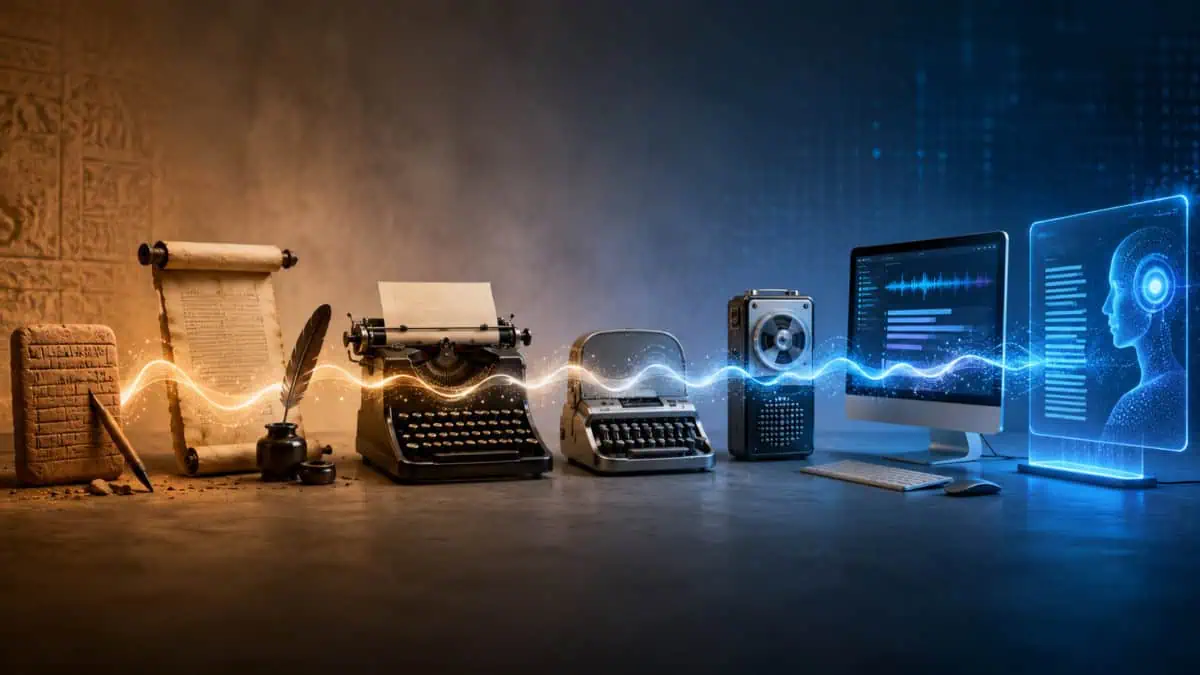
Technology has changed nearly every part of how we work, communicate, and store information. Transcription is no exception. What once required scribes, handwritten notes, typewriters, and in-person stenographers is now a digital service used by businesses, healthcare providers, law firms, government agencies, academic institutions, and law enforcement teams.
Today, transcription supports meetings, interviews, dictations, research, medical records, court proceedings, legal transcription services, and many other professional needs. The tools have changed dramatically, yet the goal remains the same: to preserve spoken information in a clear, accurate, and usable written record.
From Ancient Scribes to Written Records
The history of transcription goes back thousands of years. Long before audio files and word processors, societies relied on scribes to record laws, religious texts, royal orders, financial records, and historical events.
In ancient civilizations, writing was a specialized skill. Scribes spent years learning how to read, write, copy, and preserve information. Their work helped governments, religious institutions, merchants, and rulers keep records that could outlast spoken communication.
The materials changed over time, from clay and stone tablets to papyrus, parchment, and paper. Yet the value of transcription stayed consistent. Societies needed a reliable way to turn spoken or dictated information into written documentation.
The Printing Press and the Start of Mechanized Text
The invention of printing changed how written information could be produced and shared. Woodblock printing and, later, the printing press made it possible to reproduce text faster and on a greater scale.
While printing was not transcription in the modern sense, it changed expectations around written records. Documents could be copied, distributed, stored, and referenced more easily. This helped create a world where written information became more central to law, commerce, education, religion, and government.
That shift laid the groundwork for later tools that would make transcription faster and more practical.
Typewriters, Stenotypes, and Faster Transcription
The typewriter was one of the biggest changes in the history of transcription. Instead of writing everything by hand, trained typists could produce cleaner documents more quickly and consistently.
As typewriters became more common, typing became a professional skill. Offices, courts, hospitals, newsrooms, and businesses needed people who could turn spoken or written information into formal documents.
Then came stenotype machines, which allowed trained stenographers to record speech at high speed using shorthand. This became especially important in legal and judicial settings, where fast and accurate records were essential.
Court transcription services still reflect that need today. Proceedings, testimony, hearings, and official records require careful documentation because small errors can affect how information is later reviewed and used.
Audio Recording Changed the Workflow
Before audio recording, transcription often had to happen in real time. Secretaries, stenographers, and scribes needed to be present during meetings, hearings, dictations, or conversations.
Audio recording changed that process.
Once speech could be recorded and later played back, transcription became more flexible. Doctors could dictate notes. Business leaders could record meetings. Attorneys could preserve interviews. Government officials could document proceedings. Researchers could record conversations and review them afterward.
This made transcription more practical across many industries. It also made it easier to check accuracy because transcriptionists could replay difficult sections rather than relying solely on memory or live shorthand.
Computers Made Transcription Easier to Edit and Store
Typewriters improved speed, although they still made editing difficult. A small mistake could mean retyping a page or using correction tools. Formatting was limited, duplication was more complicated, and storage depended on physical paper.
Computers changed that.
Word processors made it easier to edit, format, save, duplicate, and organize transcripts. Transcriptionists could correct mistakes without starting over, use templates, search text, and deliver cleaner documents faster.
Digital files also changed how transcripts were stored. Instead of relying solely on paper files, organizations could store documents electronically, search for them, back them up, and share them with authorized users.
This shift was especially useful for industries that handle large amounts of documentation, including healthcare, law, business, academia, law enforcement, and government transcription services.
The Internet Made Remote Transcription Possible
The internet changed transcription from a mostly local service into a national and global workflow. Before fast file transfers, clients often needed transcriptionists nearby. Recordings might be mailed, delivered, or handled in person.
Now, audio and video files can be uploaded securely from almost anywhere. Transcriptionists can receive files, complete transcripts, and send documents back without being in the same city, state, or time zone as the client.
That shift made transcription faster and more scalable. It also gave clients more choice. A law firm, hospital, university, business, police department, or insurance company no longer has to rely only on whoever is nearby.
Remote transcription also supports different formats and workflows, including interviews, meetings, medical dictations, police recordings, academic research, insurance calls, business reports, legal recordings, depositions, webinars, and podcasts.
Deposition transcription services, for example, can now support attorneys who need accurate records without requiring every step of the process to happen in person.
Automated Transcription Is Useful, Though Still Limited
One of the biggest changes in modern transcription is the advent of automated speech recognition. AI tools can now quickly convert audio to text and can be useful in the right situation.
Where Automation Helps
Automated transcription can be helpful for rough drafts, personal notes, quick summaries, and simple recordings with one clear speaker. It can also make large volumes of audio easier to sort before a human reviews the most important parts.
For low-risk work, speed may matter more than perfect accuracy. In those cases, automated tools can save time.
Where Automation Struggles
AI tools often struggle with poor audio, multiple speakers, accents, background noise, technical terminology, overlapping speech, unclear names, and unclear numbers.
They may also miss context, speaker changes, tone, or industry-specific language. That matters when a transcript is used for medical documentation, legal review, court preparation, academic research, law enforcement files, business decisions, or trial transcription services.
Why Human Review Still Matters
Automation has improved transcription workflows, although human transcriptionists remain essential when quality and judgment matter. A trained transcriptionist can listen for context, flag unclear sections, identify speakers more carefully, and format the transcript for how it will actually be used.
For important recordings, a transcript needs to be more than fast. It needs to be accurate, readable, and reliable.
Transcription Technology at a Glance
Modern transcription is the result of many small and large changes over time. Each new tool made transcription faster, easier to store and share, or more accessible across different industries.
| Technology Shift | What Changed | Why It Mattered |
| Scribes and handwritten records | Spoken information could be preserved in writing | Created lasting records for law, government, religion, and commerce |
| Printing press | Text could be reproduced and distributed faster | Made written records easier to share and standardize |
| Typewriters | Documents could be prepared faster and more cleanly | Improved office, legal, medical, and business documentation |
| Stenotype machines | Trained stenographers could capture speech at high speed | Supported courts, hearings, and live proceedings |
| Audio recording | Speech could be recorded and transcribed later | Reduced the need for transcription to happen only in real time |
| Computers and word processors | Transcripts could be edited, formatted, saved, and duplicated more easily | Improved accuracy, storage, and document management |
| Internet file transfer | Recordings and transcripts could be sent securely from anywhere | Made remote transcription practical and scalable |
| Automated transcription | Software could create rough transcripts quickly | Improved speed, while still requiring human review for important work |
Technology has made transcription more efficient, although the human role still matters. Professional transcriptionists bring listening skills, context, judgment in formatting, confidentiality, and subject-matter awareness that software alone cannot always provide.
Transcription Today: Faster, More Flexible, and More Specialized
Modern transcription is faster and more accessible than ever. Clients can record audio on their phones, upload files via secure platforms, choose turnaround options, specify formatting preferences, and receive digital transcripts that are easy to search and share.
At the same time, transcription has become more specialized. Different industries need different types of transcripts.
Healthcare organizations may need medicolegal transcription services for records connected to both medical and legal review. Law firms may need verbatim transcripts, deposition summaries, or certified documents. Businesses may need clean meeting transcripts. Academic researchers may need interviews formatted for analysis. Law enforcement agencies may need secure handling of sensitive recordings.
Technology has made transcription more efficient, even as the human role still matters. Professional transcriptionists bring listening skills, context, judgment in formatting, confidentiality, and subject-matter awareness that software alone cannot always provide.
Why Clients Choose Ditto for Professional Transcription Services
Modern transcription relies on technology, yet the best results still require trained professionals, secure workflows, and a clear understanding of how transcripts will be used. A transcript for a business meeting, legal proceeding, medical file, police interview, or research project should be accurate, readable, and prepared with the right level of care.
At Ditto Transcripts, we help clients turn audio and video recordings into professional transcripts for business, legal, medical, law enforcement, academic, financial, insurance, government, and personal use. Our process is designed for clients who need accuracy, confidentiality, and practical documents they can review, share, store, and rely on.
Clients choose Ditto because we offer:
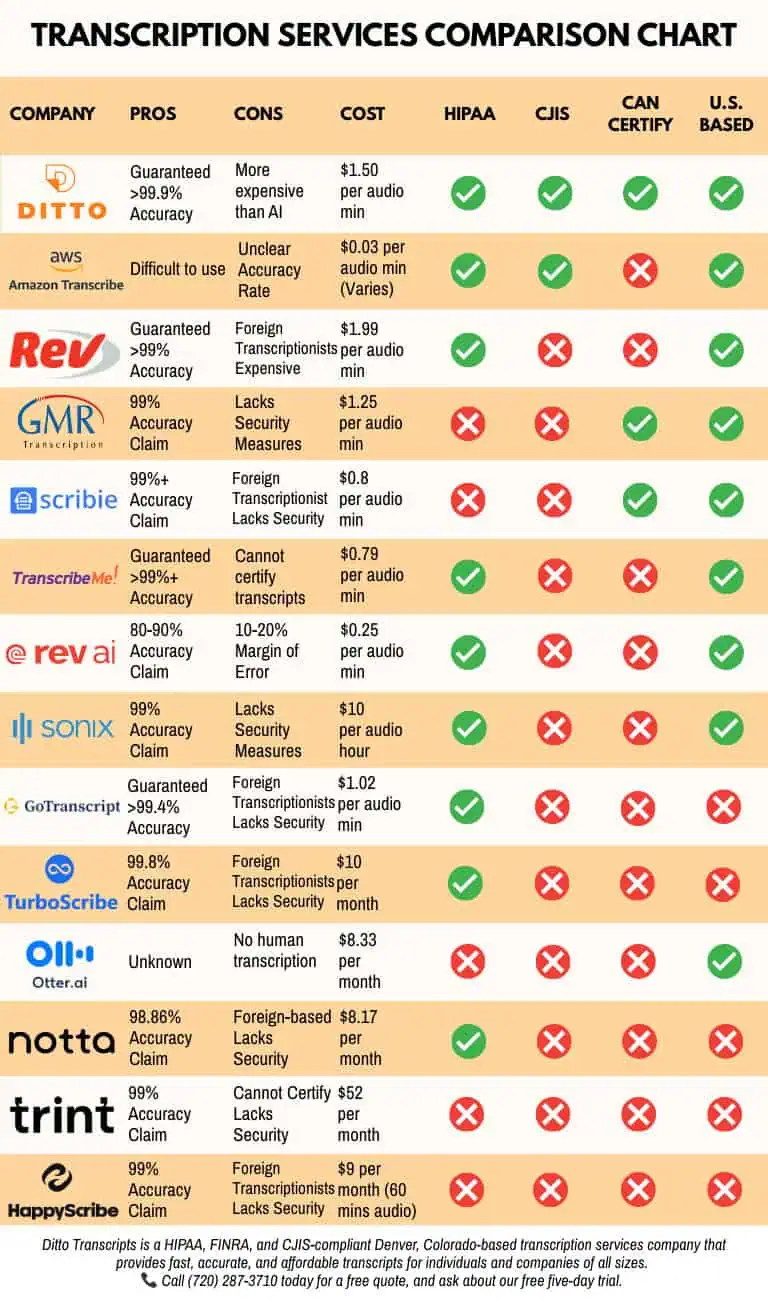
- Human transcriptionists: We use trained human transcriptionists who understand context, speaker flow, tone, terminology, and the difference between a rough transcript and a professional final document.
- Industry-specific experience: Ditto works with clients across legal, medical, law enforcement, academic, business, financial, insurance, government, and personal transcription projects.
- Verbatim transcription: When clients need every spoken word captured, Ditto can provide word-for-word transcripts that include false starts, filler words, pauses, interruptions, and other spoken details when required.
- Support for difficult audio: Our transcriptionists can work with multiple speakers, background noise, accents, low volume, overlapping speech, technical terms, and recordings that automated tools often struggle with.
- Secure handling: Sensitive recordings are handled through confidentiality-focused workflows designed to help protect client files and transcripts.
- Compliance support: Ditto works with clients who need HIPAA-, CJIS-, FINRA-, legal-, medical-, law-enforcement-, and government-compliant transcription support.
- Flexible turnaround options: Clients can choose turnaround times based on file length, urgency, audio quality, number of speakers, and project requirements.
- Clear formatting: Transcripts can be prepared in readable formats that are easier to search, review, share, store, summarize, and use in professional workflows.
- Transparent legal transcription pricing: Pricing depends on the type of transcription, turnaround time, audio quality, number of speakers, formatting, and whether the client needs certified, verbatim, or specialized transcription.
- No long-term contract required: Clients can use Ditto for one project, ongoing support, or changing transcription volumes without being locked into unnecessary commitments.
Whether you need a meeting transcribed, a legal recording documented, a medical dictation prepared, a police interview reviewed, or an audio file converted into searchable text, Ditto Transcripts can help make the process accurate, secure, and manageable.
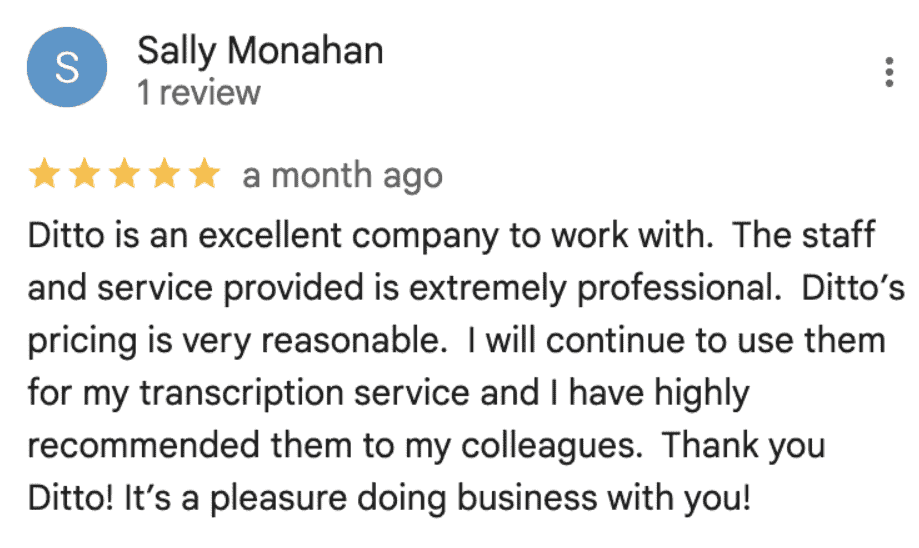
Still deciding? Here’s what one Ditto client testimonial had to say:
The Future of Transcription Is Still Human and Technical
Transcription has come a long way from clay tablets, scribes, typewriters, and stenotype machines. Technology has made the process faster, easier to store, and more flexible for clients across nearly every industry.
Still, the purpose of transcription has not changed. People still need accurate written records of spoken information.
AI and automation will continue to shape the industry, though professional human transcription remains important when recordings are sensitive, complex, technical, or tied to important decisions. The best transcription workflows use modern technology without losing the accuracy, judgment, and confidentiality that clients need.
Ditto Transcripts is a Denver, Colorado-based FINRA, HIPAA, and CJIS-compliant transcription services company that provides fast, accurate, and affordable transcripts for individuals and companies of all sizes. Call (720) 287-3710 today for a free quote.