


Attorneys handle a massive volume of documents, research, recordings, deadlines, and confidential client information. The right technology can make that workload easier to manage without replacing the professional judgment that legal work requires.
Modern tools can help law firms organize cases, collaborate securely, research legal authorities, digitize paperwork, and turn recorded proceedings into searchable records. As a provider of legal transcription services, we have also seen how much time attorneys can save when the administrative side of a case is handled efficiently.
In this article, you’ll know:
- Which technologies can make legal workflows more efficient.
- How cloud storage, transcription, scanning, and AI research tools help attorneys.
- Why security, accuracy, and human review still matter.
- How to build a legal tech stack that saves time without sacrificing control.
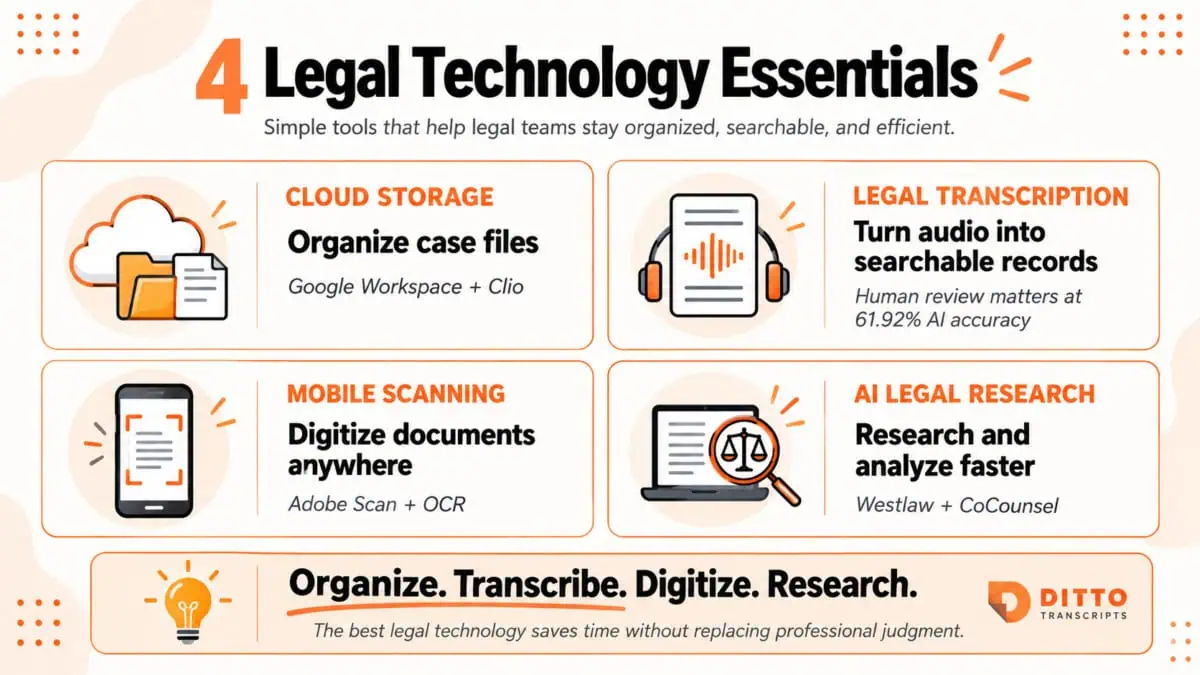
1. Cloud Storage and Case Management
Law firms may have thousands of documents connected to active and closed matters. Emailing versions back and forth makes it easy to lose track of the current file.
Cloud-based document and case management gives legal teams a central place to organize, access, and collaborate on case information.
Google Workspace remains useful for document collaboration and file sharing. Google also provides administrative controls that can restrict how files are shared internally and externally.
Legal-specific platforms go further. For example, Clio combines case management with document storage, calendaring, time tracking, billing, client communications, and other law-firm workflows. It can also integrate with services such as Google Drive, OneDrive, Dropbox, Box, and NetDocuments.
Centralized storage is especially valuable when attorneys manage lengthy records from deposition transcription services, exhibits, discovery documents, correspondence, and other matter-specific files.
2. Professional Legal Transcription
Recorded hearings, interviews, dictated notes, witness statements, and other legal audio can contain information attorneys need to find quickly.
A professional transcript turns recorded material into a document attorneys can search, quote, annotate, and review without repeatedly replaying the recording.
Ditto Transcripts works with legal recordings that require accurate speaker identification, terminology, formatting, and careful human review. Attorneys may also use court transcription services to convert recordings of proceedings into readable written records.
AI transcription can be convenient for rough drafts, but an accuracy rate of 61.92% still requires significant correction when names, legal terminology, overlapping speakers, poor audio, or important details are involved. For sensitive legal material, human judgment remains especially valuable.
3. Adobe Scan for Mobile Document Scanning
Attorneys no longer need to stand beside an office scanner every time they need to turn a paper document into a PDF.
Adobe Scan can use a smartphone or tablet camera to capture documents and convert them into PDFs. Its optical character recognition, or OCR, can also make scanned text searchable and editable.
Mobile scanning is particularly useful when a document needs to be captured, organized, or shared while an attorney is away from the office.
There is one important caveat. Legal professionals should follow their firm’s security, confidentiality, and document-retention policies before uploading client files to any cloud-connected scanning service.
4. Westlaw and CoCounsel for Legal Research
The original version of this article recommended Casetext. That recommendation needs an update.
Thomson Reuters acquired Casetext in 2023 for $650 million. Thomson Reuters later added Casetext’s CoCounsel technology to its expanding legal AI platform.
Today, Westlaw and CoCounsel offer AI-assisted tools for legal research and broader legal workflows. Thomson Reuters says its current products can support research, document analysis, drafting, litigation preparation, and other tasks while grounding research capabilities in Westlaw authority.
AI can dramatically accelerate research, but attorneys should still verify authorities, citations, quotations, and conclusions before relying on generated work.
Technology can also complement the written case record. For example, during litigation and trial preparation, searchable materials produced through trial transcription services can make it easier to locate testimony and key statements alongside other research.
In a nutshell:
Why Clients Choose Ditto for Legal Transcription
Legal transcription is more than converting speech into text. Attorneys need documents that are accurate, readable, secure, and useful throughout a matter.
At Ditto Transcripts, we provide legal professionals with dependable transcripts that reduce time spent replaying recordings and searching for key information.
Clients choose Ditto because we offer:
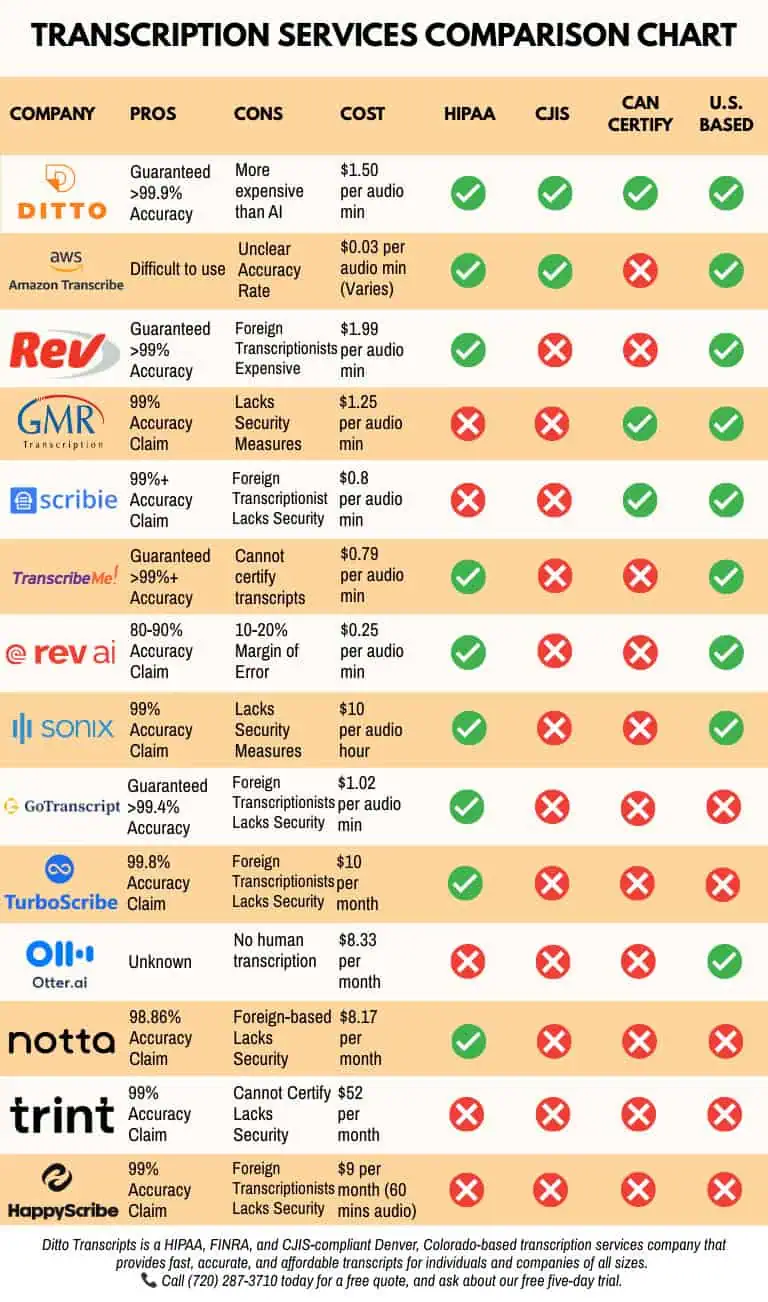
- Human transcriptionists: Trained professionals listen carefully, research terminology when needed, and review transcripts instead of relying entirely on automated output.
- Legal transcription experience: Our team works with hearings, dictated notes, interviews, depositions, court-related recordings, and other legal material.
- Flexible transcript formats: Clients can request formatting that fits the project, including verbatim transcription when exact wording and speech patterns matter.
- Support for difficult audio: Multiple speakers, accents, background noise, technical terminology, and unclear sections are handled with human judgment instead of guesswork.
- Secure file handling: Sensitive recordings are handled through confidentiality-focused workflows designed for professional transcription projects.
- Flexible legal transcription prices and turnaround options: Pricing and delivery times vary by audio quality, file length, number of speakers, urgency, formatting, and other project requirements.
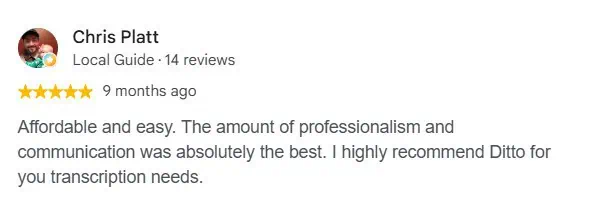
- Client testimonials: Here’s what our previous customers say about their experience.
Build a Legal Technology Stack That Saves Time
The best technology for a law firm solves a real workflow problem. Cloud platforms can keep matters organized, mobile scanning can digitize documents, legal research platforms can accelerate research, and professional transcription can make important recordings easier to use.
The goal is not to adopt every new tool. It is to choose technology that saves time, protects sensitive information, improves access to case materials, and lets attorneys spend more time practicing law.
Ditto Transcripts is a Denver, Colorado-based transcription services company that is HIPAA- and CJIS-compliant and provides fast, accurate, and affordable transcripts for individuals and companies of all sizes. Call (720) 287-3710 today for a free quote.