
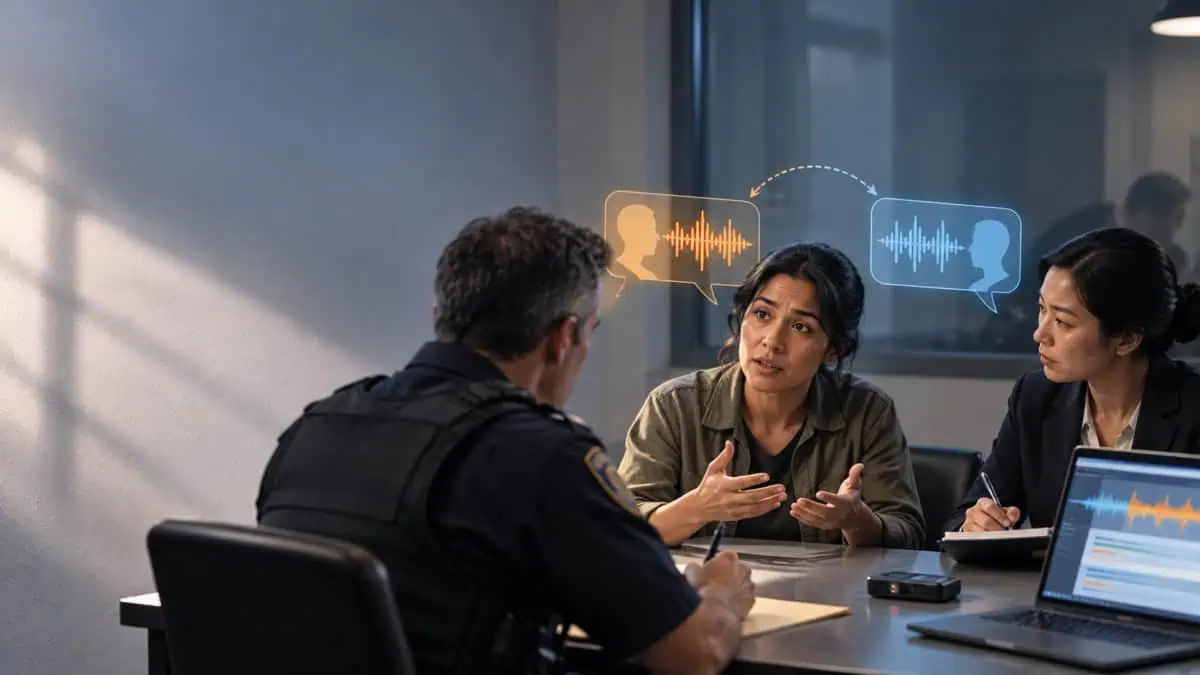
“I think the driver had a gun” is entirely different from “The driver had a gun.” Such a mistake can happen when a witness’ statement is misinterpreted.
Structurally, the two statements seem similar. However, their meanings differ entirely. A transcription error can turn an observation into a definite statement, changing how investigators and legal professionals interpret the evidence. Cases like this highlight the importance of law enforcement transcription services, particularly when multiple languages are involved.
Interviews involving interpreters are already challenging. When the resulting record contains interpretation inconsistencies, its reliability can be compromised.
In this article, you’ll learn…
- Why accurate multilingual transcription matters in police interviews.
- Where AI transcription struggles with accents, dialects, and overlapping speech.
- How transcription, interpretation, and translation differ.
- How a single incorrect word can affect legal proceedings.
- Why human review, chain of custody, and professional transcription are essential.
Two Languages, One Record
Not everyone speaks English. Several police interviews need interpreters because witnesses, victims, and suspects may speak a different language, or switch languages, during questioning.
That makes the record tricky:
*The officer asks a question in English…
*The interpreter repeats that question in Spanish to the other party…
*The other party responds in Spanish…
*The interpreter translates this Spanish response into English…
A single question involves four statements, each requiring accurate documentation. The hardest part of recordkeeping is that interviews are rarely one or two questions, which increases complexity.
The bilingual record must distinguish the original words of both parties. If not, investigators or legal professionals may not be able to trace whether an inconsistency stems from the speaker or the interpreter when they use the record.
Where AI Transcription Breaks Down
A popular alternative is AI-assisted transcription tools. These tools are fast, inexpensive, and powerful, offering both transcription and translation capabilities for recorded conversations.
Automated systems support almost all languages, which becomes more attractive when interviews involve a diverse population.
However, there is a catch. AI-transcription solutions can be inaccurate… 61.92% accuracy based on our tests.
Here’s where it struggles:
- Accents and regional dialects: AI performs best when speakers enunciate words clearly. However, strong accents, regional dialects, and variations in speech patterns can make accurate transcription more challenging.
- Code-switching: Speakers move between languages, sometimes within the same sentence, which can confuse AI.
- Overlapping speech: When two people speak at the same time, AI may not be able to distinguish who said what. Now, imagine a recording with more than 4 to 5 people speaking simultaneously.
- Poor audio quality: AI performs best in a controlled environment with appropriate recording tools and free from external noise, which is rarely the case.
A 2026 study published in Disability and Rehabilitation: Assistive Technology found that automatic speech recognition performed worse with diverse accents than with the reference American accent used in the research. More importantly, AI transcription tools may struggle to interpret human context, potentially producing inaccurate summaries or hallucinating information that was never in the original record.
Still, AI could be useful as a first draft. It is not necessarily the problem. Treating its first output as a verified legal record is.
Transcription and Translation Are Different Jobs
Many people assume transcription and translation are interchangeable, although they serve different purposes.
Here’s how they differ:
| Process | What it does | Why it matters |
| Transcription | Captures spoken words in their original language | Preserves what the speaker said |
| Interpretation | Converts speech between languages during an interview | Allows participants to communicate |
| Translation | Renders recorded or written content into another language | Makes the original statement accessible to another reader |
Each of these three processes has its own opportunities for error. If a statement is misheard before translation, as is common with AI, it records something the witness never intended to say.
Human reviewers with the appropriate language skills can compare the original audio with both written versions, identify uncertainties, and document necessary corrections, which is why legal professionals seek professional deposition transcription services.
When One Wrong Word Changes the Case
A mistranslated or inaccurate transcript could be why a case is lost.
The most basic mistakes can be fatal. A simple change from “I didn’t know what I was signing” to “I did know what I was signing” removes the negative and completely changes the intended meaning. That standard is unacceptable, especially in criminal proceedings where evidence reliability can be challenged.
Fortunately, inaccurate translations do not automatically make evidence inadmissible. Courts have measures to evaluate the evidence and the applicable legal standard. This highlights the value of professional court transcription services that capture accurate written documentation.
Language access also carries legal considerations. Title VI prohibits discrimination based on national origin in federally assisted programs. Although the Department of Justice rescinded its earlier limited-English-proficiency guidance in 2025, agencies still must comply with applicable civil rights laws and other governing requirements.
Dialects and Code-Switching Are Not Unusual
Here’s something people sometimes overlook: two individuals speaking the same language may not use the same expressions.
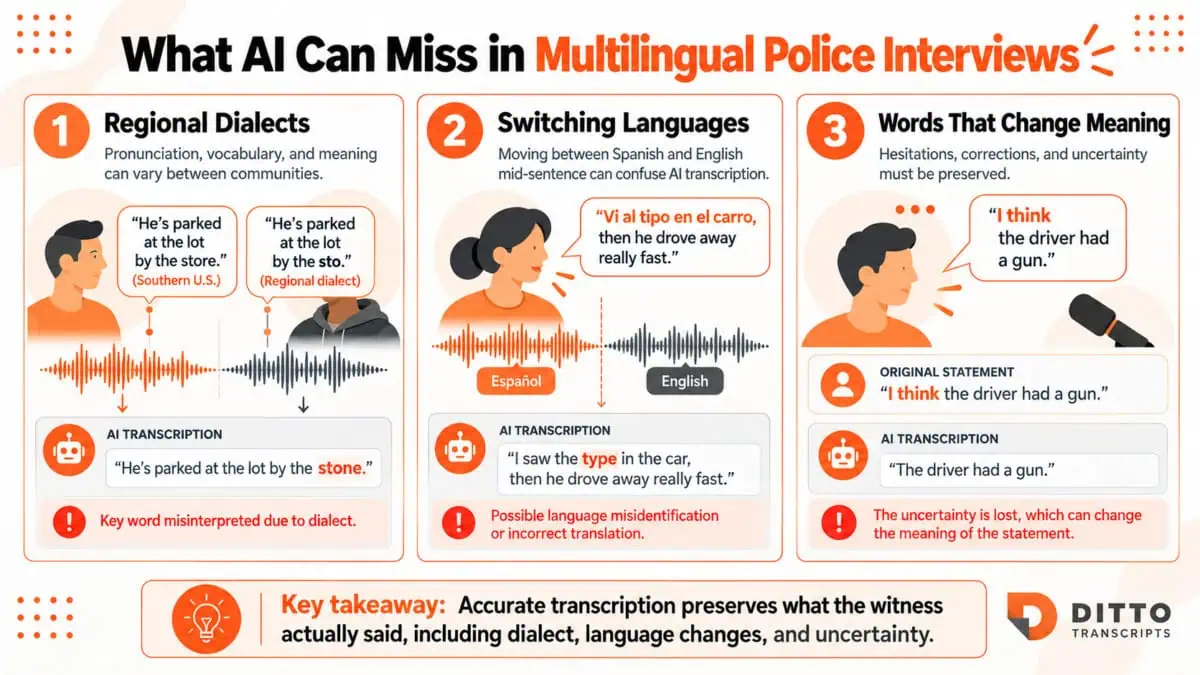
For investigative recordings, verbatim transcription preserves the original statements by capturing every spoken word, along with pauses, speech patterns, and subtle nuances that might otherwise go unnoticed.
Chain of Custody Must Account for Both Languages
A defensible record goes beyond output accuracy. It extends to:
- Identifying the recording used
- Keeping records of who handled the recording and who has access to it
- The process of preparing the final document
For multilingual interviews, another layer is who verified the translation.
On the other hand, a properly documented workflow includes the following:
- Original audio
- Accurate timestamp and speaker labels
- Revisions, if there are any
- Identified translator
- Who certified the document, if certification is required.
For law enforcement agencies using government transcription services, these safeguards help maintain consistency across sensitive recordings and official records.
Certification does not guarantee that every word is accurate. However, it helps establish accountability for the final document.
Why Choose Ditto Transcripts for Multilingual Police Interviews?
At Ditto Transcripts, we understand that a police interview is more than a conversation captured on audio. It may become part of an investigation, legal proceeding, or evidentiary review where accuracy matters.
Here’s what Ditto brings to the table:
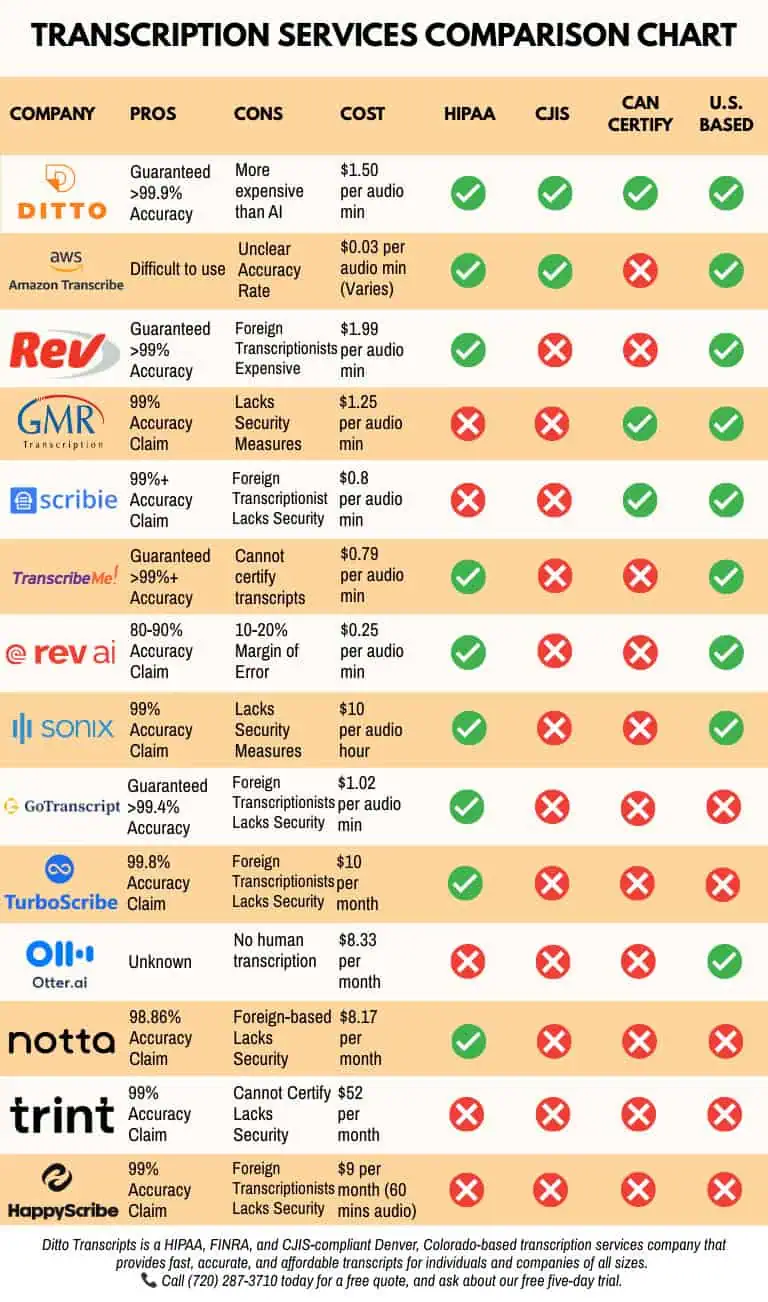
- Human accuracy: We take precision seriously and guarantee >99% accuracy on our transcripts, performed by U.S.-based transcriptionists.
- Multilingual support: Although we focus on English transcription, we also offer legal transcription and translation for supported languages, including Spanish, French, German, and Arabic. Before proceeding, message us or call to confirm any language-specific requirements.
- Security: We are CJIS-, HIPAA-, and FINRA-compliant, reflecting our commitment to the highest security standards.
- Flexible law enforcement transcription prices: Customize your transcription needs and estimate costs with our easy-to-use calculator.
- Client testimonials: If you wonder what our clients say about our service, here’s one:
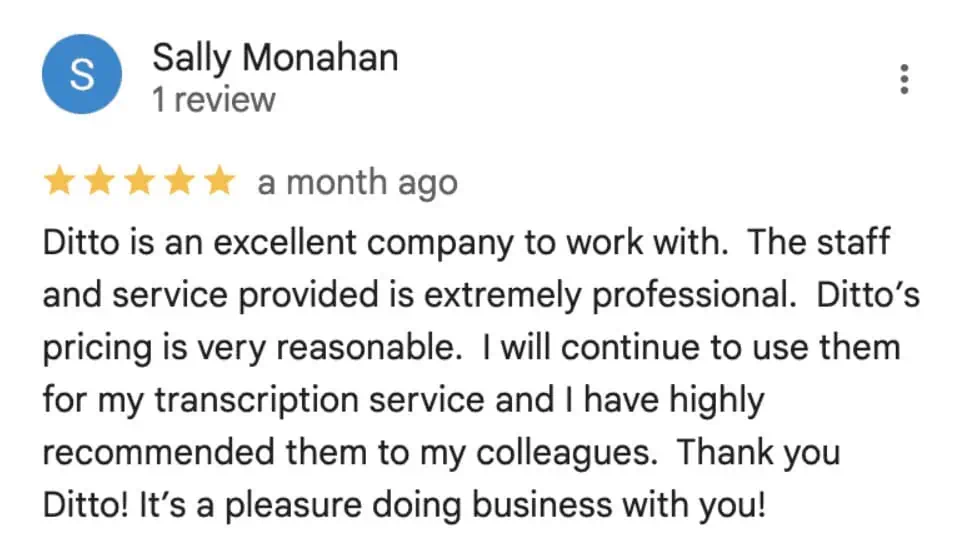
Our goal is straightforward: provide dependable documentation that professionals can review, verify, and use with confidence.
The Original Words Still Matter
Police interviews are already complicated. When multiple languages are involved, accuracy adds another layer of responsibility: capturing the original statement precisely and ensuring its meaning is accurately translated into another language.
AI-assisted technologies can help. However, they have limitations. A qualified human professional still must finalize the record, especially when someone’s rights or future may be at stake.
In an investigation, every word can matter. The transcript should preserve the speaker’s account, not introduce a different one.
Ditto Transcripts is a Denver, Colorado-based transcription company offering accurate, secure, and affordable transcription services for law enforcement agencies, legal professionals, and organizations nationwide—call (720) 287-3710 to discuss your recording or request a free quote.