
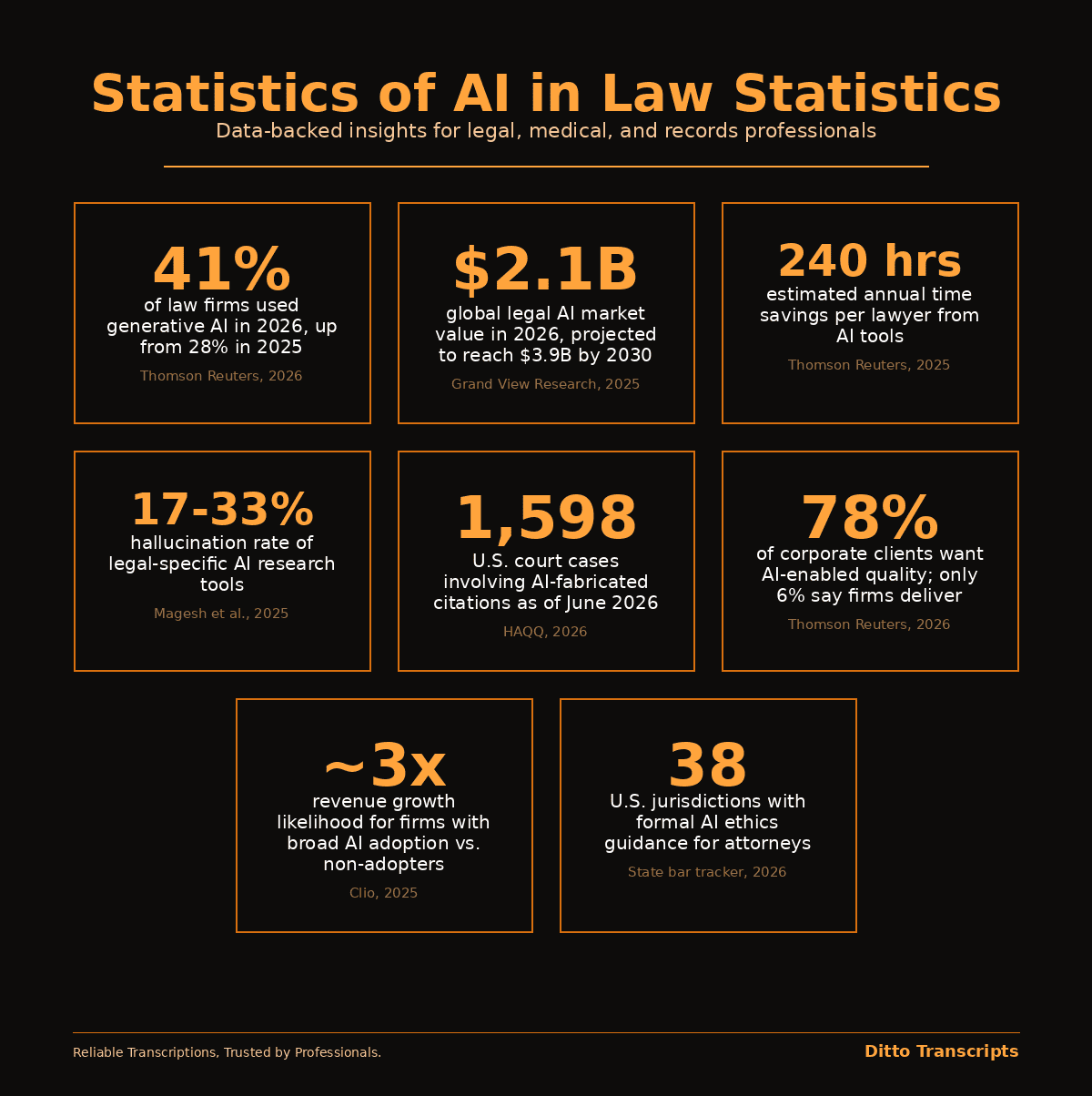
Legal AI adoption has crossed the tipping point. In 2026, 41% of law firms reported using generative AI, nearly doubling from 28% just one year earlier, according to the Thomson Reuters 2026 AI in Professional Services Report. The global legal AI market reached an estimated $2.1 billion, growing at a 17.3% compound annual rate. But growth brings risk. A Stanford-led study found that even purpose-built legal AI tools hallucinate at rates between 17% and 33%, and U.S. courts have now documented over 1,598 cases involving AI-fabricated citations.
Below is the most current data on AI’s spread, accuracy, market value, and regulatory response across the legal profession.
Summary: Key AI in Law Statistics at a Glance
- 41% of law firms used generative AI in 2026, up from 28% in 2025.
- The global legal AI market was valued at $2.1 billion in 2026 and is projected to reach $3.9 billion by 2030.
- 77% of legal professionals use AI for document review, the most common application.
- 240 hours per year in estimated time savings per lawyer from AI tools.
- Legal-specific AI tools hallucinate 17% to 33% of the time on legal research queries.
- 1,598 court cases involving AI-fabricated citations have been documented in U.S. courts as of June 2026.
- Pro se federal filings nearly doubled from roughly 23,000 to 41,490 per year by FY2025.
- 78% of corporate clients want AI-enabled quality improvements; only 6% say their firms deliver.
- 38 U.S. jurisdictions have issued formal AI ethics guidance for attorneys as of mid-2026.
- Firms with broad AI adoption are nearly 3x more likely to report revenue growth.
- The generative AI in legal market is projected to grow at a 29.9% CAGR through 2035.
AI Adoption Rates in the Legal Profession
AI adoption among lawyers has accelerated sharply. The [Thomson Reuters 2026 AI in Professional Services Report](https://www.thomsonreuters.com/en/reports/2026-ai-in-professional-services-report) found that 41% of law firms now use generative AI, up from 28% in 2025. Corporate legal departments moved even faster, climbing from 23% to 47% over the same period. Across all professional services, 40% of organizations report using generative AI, nearly double the 22% recorded the prior year.
The shift extends beyond large firms. The Clio 2025 Legal Trends Report found that firms with broad AI adoption are nearly three times more likely to report revenue growth than non-adopters. Growing firms use 12% more technology tools than stagnant or shrinking practices, and they are twice as likely to employ workflow automation for document generation, client communication, and scheduling.
How lawyers use AI reveals where the technology delivers the clearest value. According to the Thomson Reuters 2026 Future of Professionals Report, 77% of legal professionals apply AI to document review, 74% to legal research, 74% to summarize documents, and 59% to draft briefs and memos. These applications save lawyers an estimated 240 hours per year, roughly six work weeks of recovered time.
More than 80% of current AI users engage with it on a weekly basis, and over 90% expect AI to become central to their workflow within five years. The profession’s sentiment has shifted along with usage: 55% of lawyers now feel hopeful or excited about AI at work, an 11-percentage-point increase year over year. Just 2% report feeling fearful.
Accuracy, Hallucinations, and Court Sanctions
AI’s efficiency gains come with a serious accuracy problem. A peer-reviewed study by Magesh et al. in the Journal of Empirical Legal Studies (2025) tested leading AI legal research platforms and found hallucination rates of 17% for Lexis+ AI, 33% for Westlaw AI-Assisted Research, and 43% for general-purpose GPT-4. These errors included outright fabricated case citations, mischaracterized holdings, and references to inapplicable authority.
The consequences have escalated quickly. The HAQQ AI Hallucination Sanctions Tracker has documented 1,598 verified court cases involving AI-fabricated citations as of June 2026. That figure stood at roughly 200 just one year earlier, and new cases now appear at a rate of nearly eight per day. Sanctions have grown in severity as well: the landmark Mata v. Avianca decision in 2023 resulted in a $5,000 fine, while Couvrette v. Wisnovsky (District of Oregon, December 2025) imposed a record $109,700 in combined penalties. U.S. courts assessed over $145,000 in AI-filing sanctions during Q1 2026 alone. Penalties now extend beyond fines to include two-year suspensions from federal practice, revoked pro hac vice admissions, and personal liability for supervising partners.
These risks highlight why accuracy-critical legal work, from deposition transcripts to court filings, still benefits from human legal transcription. When the output will carry evidentiary weight or appear in the court record, verified human review remains the professional standard.
Regulatory bodies have moved to address the gap. As of mid-2026, 38 U.S. jurisdictions have issued some form of AI ethics guidance for attorneys, including 17 formal ethics opinions, 10 binding court rules, and 21 official guidance documents. Among legal professionals surveyed by Thomson Reuters, 96% demand safeguards for confidential data in AI tools, 94% insist on outputs grounded in authoritative legal content, and 90% require reasoning that is explainable and defensible. A full 96% believe AI representing clients in court would be an inappropriate use of the technology.
Market Growth and Investment
The legal AI market is expanding at speed. Grand View Research valued the global legal AI market at $1.4 billion in 2024, with an estimated $2.1 billion in 2026. It projects the market will reach $3.9 billion by 2030, a 17.3% compound annual growth rate. North America accounts for over 46% of the global market, while Asia Pacific is growing fastest at a 20% CAGR.
Within the broader legal AI space, generative AI represents the fastest-moving segment. Precedence Research estimated generative AI in legal at $117.68 million in 2025 and projects it will reach $1.61 billion by 2035, a 29.9% CAGR. Document review is the largest application segment, while in-house legal departments represent the fastest-growing category of end users.
Investment patterns reflect confidence in the technology, if not always in its measurement. The Thomson Reuters 2026 Future of Professionals Report found that 53% of organizations already see ROI from their AI investments. Yet only 18% track ROI formally, and 40% do not know whether their organization measures it at all. The gap between spending and measurement suggests AI investment at many firms remains more conviction-driven than data-driven.
Emerging Trends and What’s New in 2026
Several developments in 2026 are reshaping the legal AI landscape in ways the adoption numbers alone do not capture.
- The client expectations gap. The Thomson Reuters 2026 Future of Professionals Report uncovered a wide disconnect between what corporate clients expect and what law firms deliver. A total of 78% of corporate clients say AI-enabled quality improvements are very important or essential, yet only 6% say their outside counsel actually provides them. Nearly a third (32%) of corporate clients are reconsidering relationships with firms that fall behind on AI capabilities. For law firms, AI adoption is increasingly a client retention issue, not just an efficiency play.
- AI is flooding courts with pro se filings. A study by researchers at MIT and USC Shah and Levy, 2026 found that self-represented federal civil filings nearly doubled, from roughly 23,000 per year before the AI era to 41,490 in FY2025. AI-generated text appeared in 18% of pro se complaints by early 2026, up from essentially 0% before 2023. The surge concentrated in templateable case types like civil rights, foreclosure, and consumer credit actions. Despite the volume increase, case outcomes remained statistically unchanged, suggesting AI helped litigants file but did not meaningfully improve their chances of winning.
- Agentic AI is arriving. The Thomson Reuters 2026 AI in Professional Services Report found that 15% of legal professionals already use agentic AI, systems that take autonomous multi-step actions rather than responding to single prompts. Another 53% are planning or considering it. By 2030, 77% expect agentic AI to be central to their work. This shift from assistive to autonomous AI represents the next inflection point for legal practice.
Talent competition is intensifying. Among professionals experiencing a gap between expected and actual AI value at work, 24% say they are considering leaving their employer within two years. Thomson Reuters estimates the replacement cost at $232,000 per departing professional. Meanwhile, 32% of lawyers using professional-grade AI tools say they would reject a role at a firm that does not offer them. AI access is becoming a recruiting and retention factor on par with compensation and culture.
How Ditto Transcripts Helps
Ditto Transcripts helps law firms, corporate legal departments, and courts produce accurate deposition, hearing, and proceeding transcripts with certified human transcription. Every file is handled under HIPAA- and CJIS-compliant procedures by U.S.-based transcriptionists, with rush turnaround available in one to two business days. See how legal transcription works.