
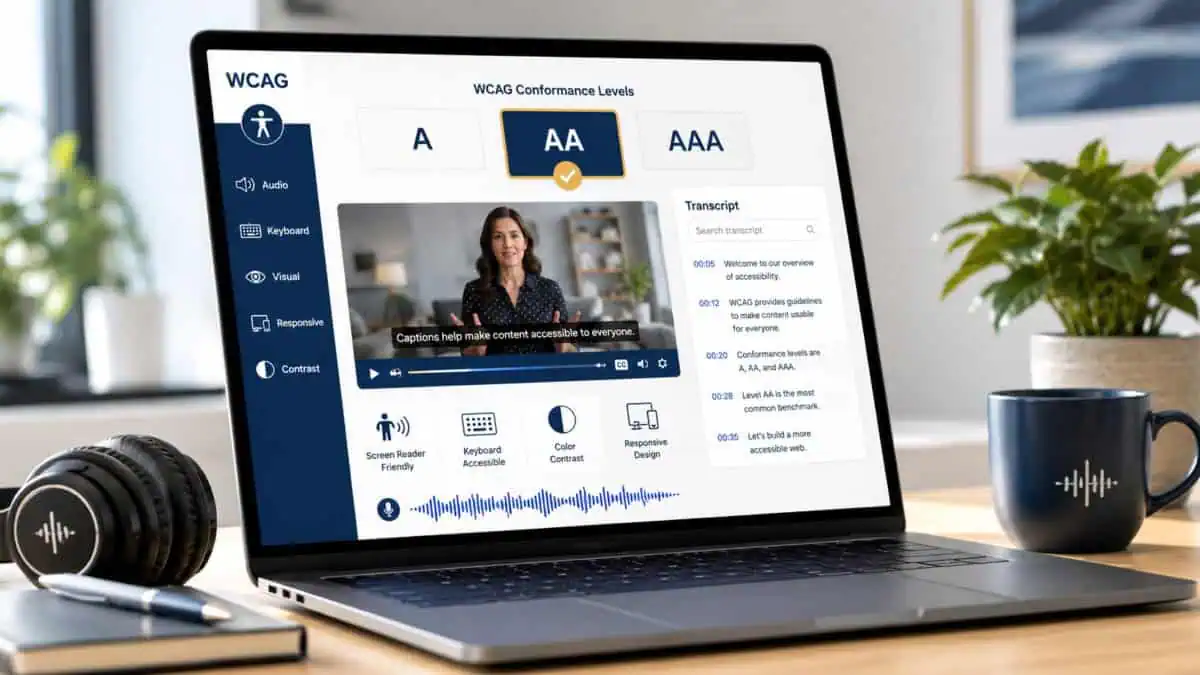
The WCAG is the gold standard for websites. For organizations that rely on audio or video content, professional WCAG transcription services also play an important role in making information easier to access, helping them meet WCAG standards. However, did you know that there are actually three conformance levels? WCAG has ratings from A to AAA, ranging from basic to the highest level of accessibility.
That brings up the question: which rating should you strive to reach? What are the requirements? And how can Ditto help you avoid the headache of non-conformance?
In this article, you’ll learn how:
- WCAG is the leading accessibility standard for websites and digital content, with three conformance levels: A, AA, and AAA.
- Level AA is the most common benchmark because it balances strong accessibility requirements with practical implementation for organizations, agencies, schools, healthcare providers, and many businesses.
- Ditto helps make WCAG Level AA more achievable by delivering accurate, human-powered transcripts that make audio and video content accessible, searchable, readable by assistive technologies, and easier for everyone to understand.
What Is The WCAG?
The Web Content Accessibility Guidelines (WCAG) are internationally recognized recommendations for improving the accessibility of websites, applications, and other digital experiences. The guidelines were developed through the World Wide Web Consortium (W3C).
WCAG is built around four core principles, more commonly known as the POUR principles. They are:
- Perceivable: Information and user interface components must be presented in ways people can perceive. For transcription, this means providing text alternatives for audio and meaningful visual content.
- Operable: Users must be able to navigate and use content. For media, this includes accessible playback controls, keyboard navigation, and enough time to read or interact with content.
- Understandable: Information and the interface’s operation must be clear and predictable. Transcripts should be accurate, well-structured, and easy to follow.
- Robust: Content must work reliably with different technologies, including assistive technologies. Transcripts, captions, and media alternatives should be formatted so that screen readers and other assistive technologies can access them.
WCAG is updated periodically to reflect the evolving needs of people with disabilities. The most current version of the guidelines is WCAG 2.2.
Now, to be clear, WCAG is not a law. However, many laws and regulations use the guidelines as the benchmark for accessibility, often linking them to the Americans with Disabilities Act (ADA). That’s why it’s in the best interest of certain website operators to meet the compliance requirements.
From A to AAA – Conformance Levels Explained
WCAG has several conformance levels that determine how accessible a website or application actually is. These levels are designed to measure the extent to which digital content meets accessibility standards, ranging from the most basic requirements to the most advanced recommendations.
The three levels are known as Level A, AA, and AAA. Let’s break down what each level represents and what they require.
Level A
Level A is the most basic WCAG level and focuses on removing major accessibility barriers. It ensures that users with disabilities can at least access and navigate core website functions. Here are the requirements:
- Provide alternative text for images so screen readers can describe them.
- Ensure users can navigate basic functions with a keyboard.
- Avoid content that flashes rapidly and may trigger seizures.
- Make links and buttons identifiable rather than relying solely on visuals.
- Provide captions or text alternatives for some multimedia content.
Level AA
Level AA is the standard most organizations aim for because it significantly improves usability and accessibility for a wider range of users. Its requirements are higher than Level A:
- Maintain sufficient color contrast between text and background for readability.
- Allow text to resize without breaking the layout or functionality.
- Use consistent navigation and labeling across pages.
- Ensure forms include clear labels, instructions, and error messages.
- Make content usable on different screen sizes and orientations.
- Improve compatibility with screen readers and assistive technologies.
Level AAA
Level AAA is the highest level of WCAG compliance and includes the most advanced accessibility recommendations. It is designed to provide the best possible user experience for people with disabilities.
- Provide even higher color contrast standards for improved readability.
- Include sign language interpretation or extended descriptions for multimedia where possible.
- Write content in simpler, easier-to-understand language.
- Offer enhanced navigation aids and contextual help for users.
- Minimize time limits and interruptions that may affect accessibility.
- Create highly adaptable experiences for users with cognitive, visual, or motor impairments.
However, W3C notes that Level AAA is not recommended as a general policy for entire sites because some content cannot satisfy all Level AAA success criteria.
Who Needs to Meet WCAG Standards?
So, with that clear, who actually needs to meet those standards? Here’s a quick list.
| Organization/Website type | Are they required to meet WCAG? | Standard commonly used |
| Federal government agencies | Yes | WCAG 2.0 A/AA via Section 508 |
| Federal contractors/vendors | Often, yes | Section 508 / WCAG 2.0 AA |
| State and local governments | Yes | WCAG 2.1 AA |
| Large state/local governments | Yes, by deadline | WCAG 2.1 AA |
| Small state/local governments | Yes, by deadline | WCAG 2.1 AA |
| Public schools/colleges | Yes | WCAG 2.1 AA |
| Private businesses open to the public | Must be accessible | WCAG AA benchmark |
| Online-only private businesses | Depends on jurisdiction | WCAG AA benchmark |
| Nonprofits | Depends | Usually WCAG AA |
| Healthcare providers/hospitals | Usually yes | WCAG AA benchmark |
| Private employers’ public websites | Often expected | WCAG AA benchmark |
As you can see, almost all agencies and institutions on this list are required to meet Level AA standards. For public agencies and related organizations, government transcription can help make official recordings, hearings, meetings, and other important materials easier to review and access.
How Level AA Requirements Affect Transcription
For transcription, Level AA compliance means transcripts need to help people who are deaf, hard of hearing, blind, low vision, neurodivergent, or using assistive technologies. The goal is simple: everyone should still be able to access the same information as everybody else.
However, that significantly widens transcription’s core objective from simple speech-to-text conversion to creating accurate, fully accessible text representations of audio or video content. In some settings, that may include verbatim transcription when every spoken word, false start, and meaningful utterance needs to be captured.
To meet Level AA expectations, transcripts should be accurate, complete, and easy to navigate. That means including all meaningful spoken dialogue, identifying speakers when necessary, and noting important non-speech sounds that affect understanding, such as laughter, applause, music, alarms, or off-screen audio cues.
Level AA also emphasizes accessibility across different devices and assistive technologies.
Transcripts should be available in text format, structured with clear headings or timestamps when helpful, and readable by screen readers. They shouldn’t be locked inside images, inaccessible PDFs, or media players that prevent users from selecting, resizing, searching, or navigating the text.
For prerecorded audio-only content, a transcript is especially important because it provides an equivalent text alternative.
For video content, transcripts can also support captions and audio descriptions by making the information easier to review, search, and understand.
How Ditto Helps Clients Meet WCAG Level AA Standards
Meeting WCAG Level AA requirements requires consistency, accessibility, and attention to detail across every stage of the transcription process.
So it’s a good thing you have Ditto as an option. We’re experts in multiple industries, and we don’t rely on AI to do the thinking and transcribing for us. For legal teams, courts, agencies, and law firms, professional legal transcription services can also help make important audio and video records more accessible, searchable, and reviewable. Here’s a quick snapshot of what to expect:

Ditto Is Your Best Choice For Meeting Level AA WCAG
With us, you’re not only getting the best in the industry. You’re also getting the full package for affordable rates.
- Experience: There’s no substitute for experience; since 2010, we’ve perfected our processes and tools to give our customers the highest level of service every single time.
- Accuracy: Accuracy is non-negotiable for lectures and research discussions. That’s why we focus on delivering transcripts with 99% accuracy.
- Human Transcribers: At Ditto, we don’t use automated transcription tools. All projects are done by humans, for humans, to ensure the highest level of accuracy.
- Speed: We know deadlines are essential, so we offer flexible turnaround times. This way, you can get the transcripts you need whenever you need them.
- Foreign Language: We offer transcription services in multiple languages. We can make your academic audio and video content accessible to foreign students.
- ADA- and WCAG-Compliant: Don’t let this become a problem by choosing the wrong provider. Our transcripts can help you support WCAG and ADA accessibility requirements.
- Security Compliance: We understand the importance of securing your data. So, we implement security to keep it confidential. When we say security, we mean CJIS, HIPAA, and FINRA compliance.
- Customer Service: We also believe in providing quality customer service. Our team is here to answer your questions or address any concerns.
Not convinced? Maybe our glowing client testimonials can convince you:

Ditto Transcripts is a Denver, Colorado-based FINRA, HIPAA, and CJIS-compliant transcription services company that provides fast, accurate, and affordable transcripts for individuals and companies of all sizes. Call (720) 287-3710 today for a free quote.