


Researchers often struggle to accurately capture and preserve large volumes of data in their pursuit of reliable findings. Transcripts play a critical role in qualitative research, with many experts recommending transcription as an essential first step to support thorough analysis and credible reporting.
Because transcription requires significant time and attention, many researchers turn to qualitative transcription companies, like Ditto Transcripts, to convert interviews and recorded data into organized, accurate text. For studies involving regulatory issues or sensitive documentation, providers that also offer legal transcription services can help ensure greater precision and record integrity.
In this article, you’ll learn:
- Transcription enhances qualitative research by creating accurate, organized records that support credible analysis and reporting.
- Written transcripts improve coding, collaboration, and bias reduction, making data easier to review, share, and validate.
- Choosing the right transcription method matters, especially for academic, clinical, or legally sensitive research where accuracy and documentation integrity are essential.
Importance of Precise Qualitative Research Documentation
Every experienced researcher knows that thorough documentation separates outstanding qualitative research from those that are “good enough.” Solid record-keeping helps them maintain transparency and enhance the trustworthiness of their results.
However, exhaustive field notes, detailed observational data, and, most importantly, verbatim transcription interviews should be front and center to achieve this. Documentation at this level can support peer evaluation, and other academics can expand on the research.
Building on the same practices, precise documentation of methodologies can help reinforce the overall soundness of qualitative research.
Different Applications Of Transcription In Qualitative Research
Transcription supports a wide range of qualitative data collection methods and analytical approaches, including:
- In-Depth Interviews: Capturing one-on-one conversations in full detail to support accurate coding and thematic analysis, similar to the structured documentation standards used in deposition transcription services when precision and speaker attribution are critical.
- Focus Groups: Documenting guided group discussions to preserve the dynamic exchange of ideas, agreements, and differing perspectives.
- Observational Research: Transcribing recorded interactions or detailed field notes from ethnographic and real-world settings.
- Academic Research: Supporting theses, dissertations, and peer-reviewed studies that examine complex social, behavioral, or theoretical concepts.
- Case Studies: Creating accurate records of interviews, meetings, and communications within in-depth individual or organizational analyses.
- Market Research: Converting focus groups, customer interviews, and user testing sessions into searchable text for consumer insight analysis.
- Healthcare and Counseling Research: Transcribing patient interviews and clinical interactions to evaluate health behaviors, treatment outcomes, and communication patterns, sometimes in coordination with providers that offer medicolegal transcription services when documentation may intersect with legal or compliance considerations.
Why Is Transcription The First Step In The Qualitative Research Process
Verbatim transcripts should be prioritized early in qualitative research because they create a secure, accessible, and analyzable foundation for the entire study.
Securing Your Research Data
Audio and video recordings are valuable, but they can be difficult to organize, search, and reference over time. Transcribing recordings into written documents preserves the original data in a stable, shareable format. High-quality transcripts may also include relevant nonverbal cues, such as pauses or tone shifts, which can add context to participant responses and prevent important details from being overlooked.
Becoming Familiar With the Data
Although transcription can be time-intensive, the process increases familiarity with the material. Researchers who review transcripts closely, whether transcribing themselves or working from completed transcripts, often begin to identify recurring themes, language patterns, and emerging concepts. This early engagement supports more informed analysis and interpretation.
Improving Accessibility and Collaboration
Transcripts are easier to code, annotate, and share than audio or video files. In large-scale studies or academic research settings, written transcripts allow multiple researchers to conduct inter-coder reliability checks and collaborate more effectively. They also make it easier to extract relevant quotations for publications, reports, and presentations. Additionally, many qualitative analysis software tools require text-based input, making transcription essential for efficient coding.
Ensuring Accuracy and Reducing Bias
Accurate transcripts allow researchers to reference participants’ exact words, which is critical for discourse analysis, phenomenological research, and other interpretive methodologies. Verbatim transcripts capture not only what was said but how it was expressed. Reliable documentation also helps reduce researcher bias by enabling repeated review of the original data.
Preparing for Systematic Analysis
Written transcripts provide a structured format for identifying themes, patterns, and trends. Researchers can highlight, code, and categorize text more efficiently than when working directly with recordings. This is particularly important in studies involving large data sets or longitudinal research, where consistency in analysis must be maintained over time.
Building a Reliable Research Foundation
Transcripts create a permanent, reviewable record that supports transparency and reproducibility. They allow other researchers to validate findings, conduct secondary analysis, or apply alternative theoretical frameworks. In academic and professional research environments, this level of documentation strengthens credibility and withstands scholarly scrutiny.
How To Get Qualitative Data Transcription
Researchers typically have three options for transcribing qualitative data: assigning the task to research assistants, using AI transcription tools, or outsourcing to professional transcription companies. Each option carries different implications for accuracy, time investment, and research integrity.
Comparison of Transcription Options
| Factor | Research Assistants | AI Transcription Tools | Professional Transcription Companies |
| Cost | Uses internal resources but requires training and supervision | Low cost or subscription-based | Per audio minute pricing |
| Time Investment | 3 to 10 hours per hour of audio, depending on the detail level | Immediate draft output | Turnaround based on the selected timeline |
| Accuracy | Varies depending on training and experience | Approximately 61.92%, affected by accents and background noise | Up to 99% accuracy with experienced human transcriptionists |
| Training Required | Yes, including a briefing on formatting and research standards | No training required | No internal training required |
| Editing Needed | Moderate to extensive review | Significant proofreading and corrections | Minimal editing required |
| Risk of Errors | Inconsistent formatting or missed detail if undertrained | Struggles with nuance, overlapping speech, and technical terminology | Structured quality control and formatting consistency |
| Best For | Small projects with flexible timelines | Rough drafts or preliminary review | Academic, clinical, legal, and publication-ready research |
When selecting a transcription approach, researchers should consider how the transcripts will be used and reviewed. For exploratory work, internal support may be sufficient. However, for publication, regulatory review, or documentation that may face external scrutiny, professional standards become essential, as in court transcription services, where accuracy and record integrity are critical.
Looking for a Research Transcription Company with Straightforward Processes? We’re Here to Help
At Ditto Transcripts, we understand that transcription is foundational to qualitative research. Our experienced transcriptionists are trained to support the precision, consistency, and intellectual integrity your studies require.
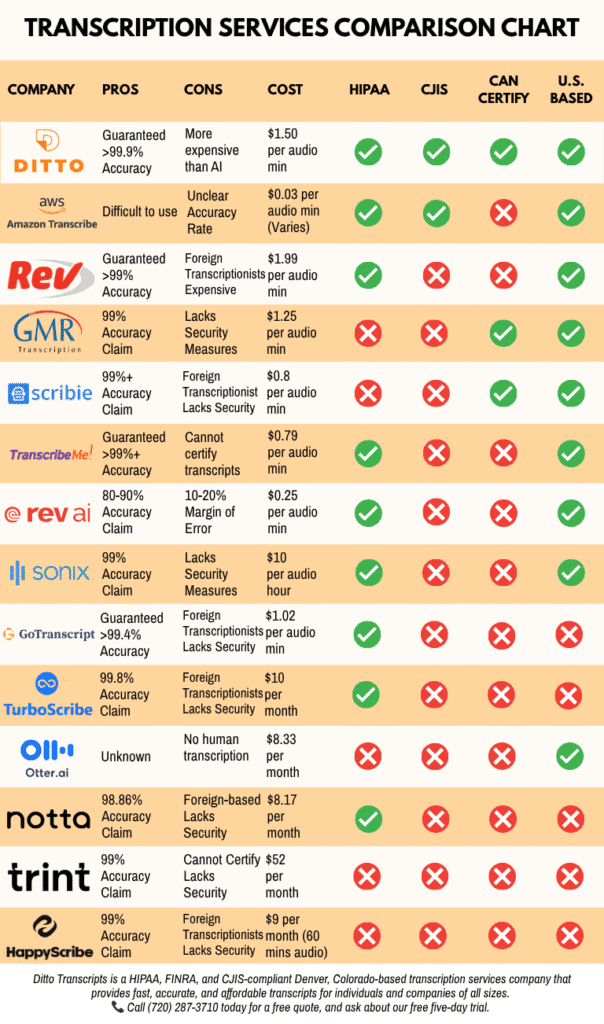
- Accuracy You Can Rely On: We provide up to 99% accuracy through skilled human transcriptionists who understand the importance of verbatim detail in academic and professional research.
- Secure and Confidential: All files are handled through secure channels, helping protect sensitive research data and participant information.
- Transparent Legal Transcription Pricing: Our pricing is competitive and clear, whether you need research transcripts or specialized legal transcription services. You won’t face hidden fees, and we offer options to fit a range of budgets.
- Flexible Turnaround Options: Whether you need standard delivery or expedited service for time-sensitive projects, we offer turnaround times that align with your research schedule.
- Dedicated Support: Our team is available to guide you through submission, formatting preferences, and delivery to ensure your transcripts meet project specifications.
- Hear From Our Clients: Researchers, faculty, and practitioners trust Ditto for reliable transcription. Our client testimonials consistently highlight accuracy, responsiveness, and ease of process.
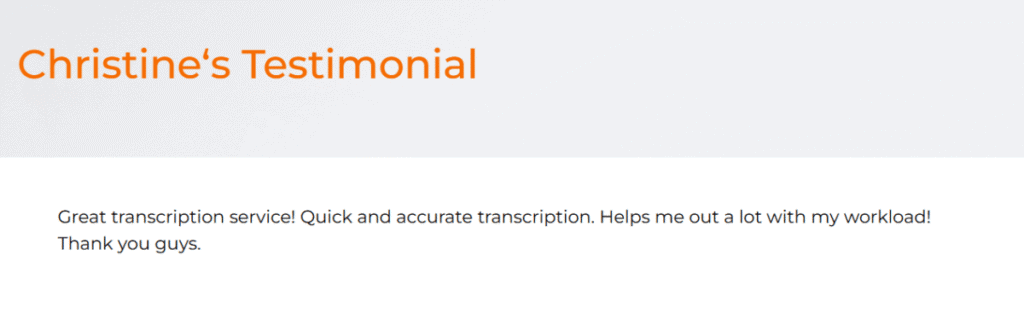
With a straightforward workflow, transparent pricing, and a commitment to quality, Ditto Transcripts helps researchers focus on insights and discovery rather than administrative burden.
Ditto Transcripts is a Denver, Colorado-based FINRA, HIPAA, and CJIS-compliant transcription services company that provides fast, accurate, and affordable transcripts for individuals and companies of all sizes. Call (720) 287-3710 today for a free quote.