


Qualitative research depends on accurately capturing complex human interactions. Tone, context, speaker dynamics, and subtle language patterns all shape meaning, making precision essential when analyzing and coding data.
As institutions look for efficiency, some turn to automated transcription. While AI tools offer speed, they often struggle with accents, overlapping speech, and technical terminology, which can compromise research integrity. For this reason, many institutions rely on experienced qualitative transcription companies such as Ditto, whose standards often mirror those required in legal transcription services where accuracy and defensibility are critical.
How can research bodies balance technological efficiency with human expertise? And what are the implications of relying on automated transcription for qualitative research?
In this article, you’ll learn:
- Automated transcription accuracy falls short for qualitative research. With reported accuracy rates around 61.92% and, in some cases, significantly lower, AI-generated transcripts can introduce errors that compromise coding, thematic analysis, and overall research integrity.
- Human transcription captures nuance that AI misses. Tone, speaker dynamics, cultural references, technical terminology, and contextual meaning are essential in qualitative studies. Skilled human transcribers apply judgment and contextual understanding that automated systems cannot reliably replicate.
- Relying solely on AI raises ethical and compliance concerns. Sensitive research data requires strict confidentiality, regulatory compliance, and defensible documentation. In high-stakes academic and legal environments, human oversight remains critical to protect participant privacy and ensure credible, review-ready records.
What Is An Automatic Transcription?
Automatic transcription, also known as automated speech recognition (ASR), is a solution powered by artificial intelligence that transcribes audio and video across industries.
How Automated Transcription Works:
- Step 1: Upload a video or audio file to an AI transcription platform or application.
- Step 2: Alternatively, dictate speech directly into the software using a compatible device.
- Step 3: The system processes the recording using speech recognition technology to identify and convert spoken words into text.
- Step 4: A transcript is generated either instantly or after automated processing.
- Step 5: Depending on the workflow, the output may be reviewed and edited by a human transcriber or proofreader.
In fully automated systems, the transcript is produced with little to no human intervention.
While this approach may offer convenience, it does not always meet the precision required in formal or high-stakes environments. In settings where accuracy, verification, and accountability are critical, such as academic research or court transcription services, human oversight remains essential to ensure the integrity of the official record.
What’s Good About AI Transcription Tools?
Anyone not living under a rock knows that AI is the next big thing in tech. Anything plastered with “artificial intelligence” is bound to have some pull. Artificial intelligence’s most prominent feature is its ability to learn. Here are some of the ways it can feed upon information
| Learning Method | Description |
| Supervised Learning | AI learns from labeled data and makes predictions based on human input-output pairs. |
| Unsupervised Learning | AI can discover patterns in unlabeled data without guidance, which is useful for tasks such as clustering. |
| Reinforcement Learning | AI learns through trial and error by interacting with an environment, aiming to maximize rewards. |
| Transfer Learning | AI leverages knowledge from one task to improve performance on a related task, reducing data needs. |
| Online Learning | AI learns continuously from incoming data streams, updating its model in real time. |
| Data Augmentation | AI artificially increases training data diversity by applying transformations like rotation. |
| Ensemble Learning | AI selects informative data points for human labeling, optimizing learning with relevant examples. |
| Active Learning | AI selects informative data points for labeling by humans, optimizing learning with relevant examples. |
| Meta-Learning | AI learns to learn by acquiring knowledge about learning strategies, aiding adaptation to new tasks. |
While AI transcription tools offer scalability and efficiency through advanced machine learning techniques, their performance ultimately depends on the quality of the training data and the algorithm design. In environments where documentation must meet strict standards of accuracy, accountability, and compliance, such as academic institutions and government transcription services, human oversight remains an essential safeguard.
Is Automatic Transcription Good For Qualitative Research
We can’t deny that artificial intelligence is a blessing to researchers worldwide. With it, pattern recognition, predictive analysis, experimental procedure automation, research data optimization, and better simulation are undoubtedly faster.
Perceptive readers might notice that transcription is ostensibly absent on this list. Why is that?
That’s because current research puts the accuracy rate of speech recognition and AI transcription at 61.92%. 61.92% accuracy may be fine for taking notes or setting up reminders—anything that doesn’t require professional or procedural use.
However, 61.92% accuracy is simply unacceptable for research projects.
| Factor | AI Transcription (≈61.92% Accuracy) | Human Transcription |
| Baseline Accuracy | Performance may decline significantly in complex audio environments. | Consistently higher accuracy with structured review processes. |
| Technical Terminology | Prone to misinterpreting discipline-specific language. | Better equipped to recognize and verify specialized terminology. |
| Multiple Speakers | Struggles with speaker differentiation and overlapping dialogue. | Accurately distinguishes speakers and preserves conversational flow. |
| Contextual Nuance | Limited contextual understanding; relies on pattern recognition. | Applies human judgment to interpret tone, emphasis, and meaning. |
| Research Integrity Risk | Error rates may affect coding, analysis, and reproducibility. | Supports defensible, reliable documentation suitable for academic standards. |
| Suitability for Institutional Use | May require substantial manual correction before formal submission. | More appropriate for research, publication, and compliance documentation. |
Crucial Reasons Not To Use AI Transcription For Qualitative Research
There are many reasons why you shouldn’t rely on automatic transcription for qualitative research than risking precision for the sake of being “faster.” Here are the reasons you shouldn’t consider automatic transcription as good enough for qualitative research:
- Risk of Data Misinterpretation: Qualitative analysis relies on verbatim accuracy for coding and thematic development. AI systems often miss nonverbal cues, emotional tone, cultural references, accents, and background context, increasing the likelihood of misinterpretation that can affect research outcomes.
- Undermining Research Credibility: Academic reviewers closely evaluate research methodology and data integrity. Studies that rely solely on unverified machine-generated transcripts may face scrutiny over reliability and validity, potentially weakening institutional credibility.
- Ethical Concerns in Data Handling: Qualitative studies frequently involve sensitive topics and vulnerable populations. Automated transcription platforms may raise concerns regarding data privacy, confidentiality, and compliance with IRB agreements or institutional data protection standards.
- Compromised Analytical Accuracy: Qualitative research often involves iterative transcript review. Even small transcription errors can compound during coding and thematic analysis, potentially distorting findings and conclusions.
- Potential Legal and Regulatory Exposure: Inaccurate transcription can carry legal risks in regulated research environments, particularly where personal data, confidential information, or investigative materials are involved. Compliance with frameworks such as the GDPR and other data protection laws requires adherence to strict handling and documentation standards.
In qualitative research, transcription accuracy directly affects analysis, credibility, and compliance. While automated tools may offer efficiency, they cannot consistently meet the precision required for scholarly work where findings must withstand peer review and institutional scrutiny. These same standards apply in high-stakes legal environments, where trial transcription services depend on exact, defensible records. When documentation matters, accuracy should never be compromised.
How Should You Get Qualitative Data Transcription Then?
There are two ways to get a transcript: research assistants or commercial transcription companies. Let’s discover the pros and cons of each.
| Evaluation Factor | Research Assistants | Professional Transcription Company |
| Time Commitment | Transcription is highly time-intensive. Without specialized training, assistants may require significantly more than three to four hours per audio hour. | Experienced transcriptionists follow established workflows, often delivering faster and more consistent turnaround times. |
| Accuracy and Consistency | May lack formal transcription training, increasing the likelihood of formatting inconsistencies or overlooked details. | Trained professionals use structured quality control processes to ensure higher accuracy and standardized formatting. |
| Resource Allocation | Diverts assistants from higher-value tasks such as data collection, coding, and analysis. | Allows research teams to focus on methodology, interpretation, and publication. |
| Cost Considerations | May appear cost-effective initially, but hidden time costs can affect overall research efficiency. | Involves direct service fees but can improve operational efficiency and project timelines. |
| Confidentiality and Compliance | Internal handling may simplify oversight, but still requires secure data protocols. | Reputable providers implement confidentiality agreements and structured data protection measures. |
Benefits Of Professional Transcription For Qualitative Data Analysis
Research objectives and the nature of the data may change, yet the benefits of transcription are of great importance to all researchers.
Accurate Transcription Process
Qualitative research may require a deeper immersion in the data. Professional transcription services offer high accuracy in converting spoken words into written text. Accurate transcripts ensure researchers have a reliable textual representation of their audio or video data, which can be used for manual analysis or with computer-assisted qualitative data analysis software.
Having inaccurate transcripts, meanwhile, can inflate workloads and negatively impact productivity. Speaking of which—
Enhanced Analysis
As mentioned earlier, transcripts make it easier to perform qualitative analysis techniques such as coding, thematic analysis, or discourse analysis. Researchers can easily read through collected data transcripts, annotate them, and identify patterns and themes. Depending on the research, data from transcripts can also be fed into advanced analysis tools, such as AI, to reduce work time.
Ease of Sharing and Collaboration
Sure, multi-gigabyte interview videos for academic research can be stored in flash drives or uploaded to the internet for sharing. Unfortunately, even with the fastest internet speeds, uploading still takes time.
On the other hand, transcripts occupy only a fraction of the space, making them easy to store and access.
That’s why transcribed data is more accessible to share with team members, advisors, or other stakeholders involved in the research. Furthermore, it facilitates collaboration, as research members can review, annotate, and comment on the same text document—something that could be done face-to-face back in the day.
Reduces Work Time
Conducting qualitative research requires a significant time commitment.
Using transcription services, researchers can save valuable time and focus on data collection and analysis—arguably the most critical aspects of any project.
Ensuring Security And Privacy
Transcription services will have unprecedented access to your research data and methodology, so you need to be able to trust them with both the accuracy of transcription and the security of your information.
Look for providers that offer high-quality encryption, elevated user access management, scaled network redundancy, VPN integration, and compliance with various regulatory bodies to protect your qualitative research data.
And yes, Ditto checks all the boxes.
Don’t Settle For Automatic Transcriptions In Qualitative Research
The significance of transcription for qualitative researchers worldwide cannot be understated. However, this all depends on choosing the right transcription service.
So, here are the top considerations when looking through the types of data transcription service providers out there—and how Ditto meets and exceeds all requirements:

- Accuracy: Ditto offers 99.9% accuracy for qualitative data transcription services
- Confidentiality: Our security measures are CJIS, FINRA, and HIPAA compliant, ensuring full control over safety and confidentiality
- Experience: Ditto has provided qualitative transcription in varying fields since 2010.
- Turnaround Time: In a hurry? Get your transcripts in 24 hours or less for rush projects.
- Transcriptionists: We only work with the best human US-based transcriptionists in the market. We don’t allow AI (or any other omniscient beings, for that matter) in our process.
- Cost: Enjoy our competitive legal transcription pricing without compromising on quality. We also offer more economical options if you’re on a tight budget.
- Customer Support: Contact us for anything you need, and we’ll get back to you as soon as we can
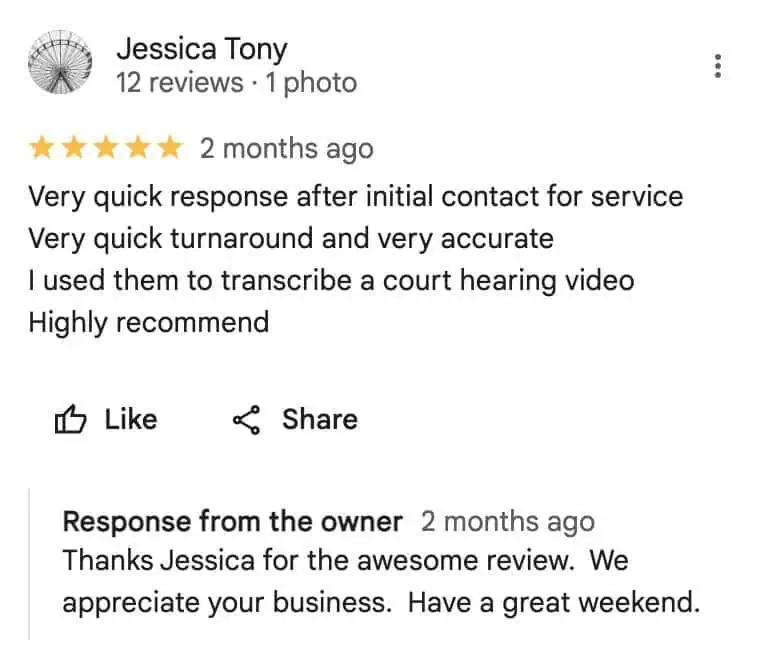
With Ditto, you’re getting your money’s worth. That’s, at least, what our client testimonial says:
So, what are you waiting for? Inquire and get the best manual transcription services today.
Ditto Transcripts is a Denver, Colorado-based FINRA, HIPAA, and CJIS-compliant transcription services company that provides fast, accurate, and affordable transcripts for individuals and companies of all sizes. Call (720) 287-3710 today for a free quote.