

There’s no question: technology is shaping learning in universities and other higher education settings. However, some educational institutions face challenges when integrating modern systems into their learning environments, including budget constraints, resistance to change, and a lack of technical expertise among staff. Keeping up with technology is important, but sometimes it helps to focus on the fundamentals, like hiring a reliable academic transcription company to support accessibility and learning efficiency. In parallel, legal transcription services highlight how accurate, professionally prepared transcripts are essential in structured, high-stakes environments, reinforcing the value of precision across both education and law.
In this article, you’ll learn how:
- The COVID-19 pandemic forced schools to offer both online and in-person classes. Technology provides students and faculty with instant access to vast amounts of information essential for remote viewing.
- Collaboration tools like Microsoft Teams and Google Workspace enable students to collaborate easily despite the distance.
- Transcripts can serve as immediate tools for learning in medias res or as supplementary instructional materials after the fact.
- A reliable academic transcription company like Ditto Transcripts ensures clarity, accessibility, and accuracy in digital learning environments.
How Important Is Technology In Higher Education?
Educational institutions that keep up with the latest tech have a better chance of improving their learning environment. Multiple educational apps and virtual classrooms are shaping how knowledge is passed around. This can also help students prepare for the job market, as schools can connect to businesses and spark ideas that contribute to the overall economy.
However, staying current with the latest technology isn’t just a nice-to-have. It’s standard for schools that want to stay in the race—or win.
As a result, colleges and universities should be ready to handle new challenges as they emerge. Alongside digital learning tools, services like government transcription services demonstrate how accurate documentation supports transparency, accessibility, and accountability, reinforcing the role of reliable transcripts in both education and the public sector as institutions prepare students to thrive in the real world.
Academic Settings Where Modern Tech Is Crucial
Here are some of the many applications of tech in learning:
| Setting | Tech Involved | Explanation |
| Online Learning | Learning Management Systems, video conferencing, and digital resources | Technology enables remote learning, facilitates communication, and provides access to a wide range of educational materials. |
| Research | Databases, data analysis software, and collaborative tools | Modern tech enables efficient data collection, analysis, and collaborative research, leading to more accurate results. |
| Library Services | Digital catalogs, e-books, online databases | Technology provides students and faculty instant access to vast information and resources, enhancing research capabilities. |
| Classroom Instruction | Interactive whiteboards, multimedia presentations, and student response systems | Technology engages students, supports various learning styles, and enables real-time feedback. |
| Laboratory Work | Computer simulations, data acquisition systems, virtual labs | Modern tech allows for safe, cost-effective, and accessible lab experiences and precise data collection and analysis. |
| Accessibility Services | Assistive technologies, text-to-speech software, screen readers | Technology helps create an inclusive learning environment by providing tools and accommodations for students with disabilities. |
Across these settings, technology works best when it improves clarity, accessibility, and accuracy. Written records of spoken content play a key role in supporting learning, research, and inclusion. The same need for precision applies beyond education, where court transcription services ensure that critical spoken information is captured accurately for official records, compliance, and accountability.
How Technology Shapes Learning In Higher Education and Its Future
Given current trends and the widespread availability of the Internet, technology has affected the learning experience in higher education more than anyone could imagine. Below are some of the most impactful ones.
- Virtual & Blended Learning: Combines in-person instruction, online platforms, and video conferencing to give students flexibility without sacrificing structure. Tools like Canvas LMS and Google Classroom support both real-time and self-paced learning.
- Course Administration Platforms: Learning management systems such as Canvas and Blackboard serve as a centralized hub for materials, assignments, discussions, and assessments, with analytics that support personalized instruction.
- Digital Content & Interactive Materials: On-demand access to e-textbooks, online journals, and multimedia resources helps students grasp complex topics while improving cost efficiency and learning convenience.
- Collaboration & Communication Tools: Platforms like Microsoft Teams and Google Workspace enable real-time collaboration, document sharing, and virtual discussions, while VR and AR enhance interactive learning experiences.
- Mobile Learning Access: Smartphones and tablets enable students to access coursework anytime, with mobile-friendly apps, deadline reminders, and offline resources that support learning on the go.
- Academic Transcription Services: Human-generated transcripts of lectures and seminars ensure accurate terminology, improve accessibility for hearing impaired and non native speakers, and support efficient review of complex material.
As technology continues to reshape higher education, tools that improve clarity and accessibility remain essential. The same digital shift has also transformed the legal world, where accuracy and documentation are equally critical. In education, academic transcripts support learning across digital environments, and trial transcription services give institutions a low-risk way to evaluate quality, reliability, and effectiveness before fully integrating transcription into their learning strategies.
What’s The Best Transcription Service For Higher Education?
Different providers offer transcription for educational institutions. Let’s talk about the two most common types you’ll find in the market.
| Category | AI Transcription | Human Transcription |
| How It Works | Uses artificial intelligence and automated speech recognition to convert audio or video into text. | Handled entirely by trained human transcriptionists. |
| Speed | Very fast, often near instant results. | Slightly slower, but delivered within reliable turnaround times. |
| Cost | Typically cheaper or free. | Higher upfront cost, reflecting quality and accuracy. |
| Accuracy | Low accuracy due to background noise, accents, overlapping speakers, and poor audio quality. | High accuracy through contextual understanding and careful review. |
| Context & Nuance | Cannot interpret nuance, tone, or intent. | Accurately captures meaning, context, and speaker intent. |
| Readability | Often produces unpunctuated, unstructured text. | Proper grammar, punctuation, and clear formatting. |
| Suitability for Education | Acceptable only for rough notes or one-off use. | Ideal for official lecture transcripts and academic materials. |
| Impact on Students | Errors can confuse learners and disrupt comprehension, especially for hard-of-hearing students. | Clear transcripts improve understanding and accessibility. |
| Editing Required | Significant manual editing is usually needed. | Minimal to no editing required. |
| Additional Features | Limited customization and formatting options. | Timestamps, formatting standards, and multiple file formats are available. |
Accuracy in transcription is not a minor detail. It directly affects understanding, accessibility, and outcomes. The consequences of getting it wrong can be severe, as demonstrated by a widely cited $140 million wrongful death verdict in which a transcription error involving an insulin dosage played a critical role. One incorrect word changed the meaning of a medical order, with tragic results.
This is why accuracy remains non-negotiable not only in education but also in high-stakes fields supported by medicolegal transcription services, where precision protects students, patients, professionals, and institutions alike.
Help Technology Shape Learning In Higher Education With Ditto Transcripts
Maximize the benefits of lecture transcription by partnering with the industry’s best service provider.

Ditto Transcripts guarantees 99% accuracy on all transcription work. Our team of professional transcriptionists can transcribe everything. Whether audio or video recordings of lectures, interviews, or meetings—you name it, we’ll do it with exceptional accuracy. Every transcriptionist we work with is bound by strict confidentiality agreements, so you can trust that any verbatim transcription is secure.
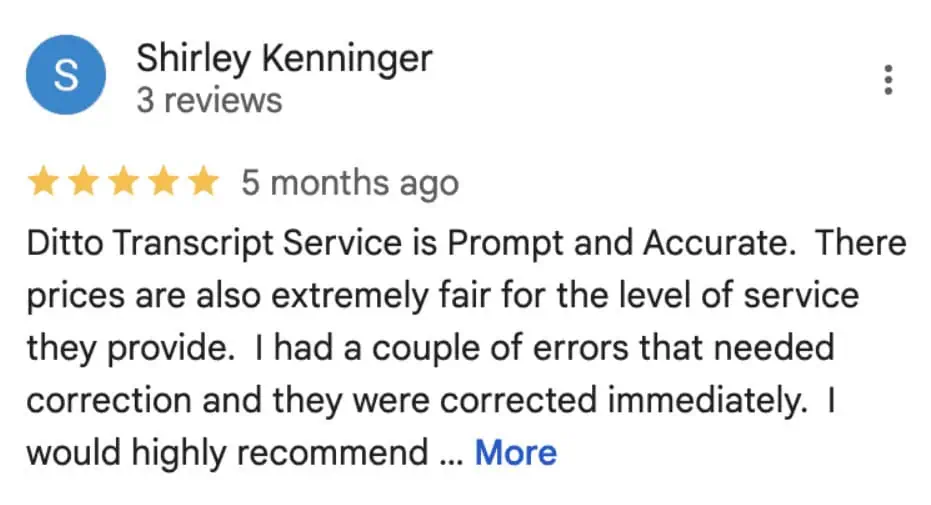
We also offer expanded services, customization options, fast turnaround times, and, best of all, legal transcription prices that do not break the bank. Don’t just take our word for it. A client testimonial can show you firsthand how professional transcription has helped various industries:
Ditto Transcripts is a Denver, Colorado-based FINRA, HIPAA, and CJIS-compliant transcription services company that provides fast, accurate, and affordable transcripts for individuals and companies of all sizes. Call (720) 287-3710 today for a free quote.