


Artificial intelligence is one of the most significant technological breakthroughs in recent memory. It’s everywhere now, from practical (data processing, robotics, computing, etc) to weird (fortune-telling, beer-making, and… brushing people’s teeth). Unsurprisingly, some medical facilities and practices consider using AI over human-powered medical transcription services. This has led some people to ask whether the medical transcription field is dying.
Unfortunately, it’s not that cut and dry. And while AI has wide-scale applications, medical transcription is not one of them. The same is true for any work that demands precision and contextual understanding, such as a legal transcription service. Let’s talk about why.
In this article, you’ll learn how:
- AI transcription only reaches 61.92% accuracy, which is far too low for critical fields like medical and legal documentation.
- Medical transcription demands contextual understanding and precise interpretation—something only trained humans can reliably provide.
- Using services like Ditto Transcripts ensures over 99% accuracy, HIPAA compliance, fast turnaround times, and customizability tailored to healthcare needs.
What Is Medical Transcription?
Medical transcription is the process of converting audio or video content related to the healthcare field into accurate text. As such, a medical transcriptionist’s job is to be a doctor’s ears and fingers.
Transcriptionists listen to recordings of patient consultations that cover medical history, symptoms, and diagnosis. Furthermore, notes about surgeries, medical evaluations, and all the essential details could also be dictated. Then, with typing skills, good spelling, and a good grasp of medical vocabulary, they convert those voice reports into accurate medical documentation. It is one of the most essential jobs in healthcare.
That said, a transcriber’s job isn’t just listening and typing—it’s decoding doctors’ dictations fluently so other medical staff can carry them out.
Who Needs Medical Transcription?
Here’s a list of medical professionals who need transcription.
| Who Needs It | Why? |
| Physicians | Doctors across various specialties need transcripts for accurate patient documentation. |
| Hospitals and Clinics | Healthcare facilities require transcribed records for comprehensive patient care. |
| Mental Health Professionals | Therapists and counselors use transcripts to document sessions and treatment plans. |
| Legal Firms | Law firms handling medical cases need transcribed records as evidence. |
| Medical Researchers | Researchers rely on transcripts to document study protocols, data, and findings. |
| Insurance Companies | Insurers may require transcribed medical records for claims processing. |
| Public Health Organizations | Agencies like CDC and WHO use transcripts for disease surveillance and initiatives. |
Is The Medical Transcription Field Dying Because of AI?
According to the U.S. Bureau of Labor & Statistics, employment of medical transcriptionists is projected to decrease by 4% from 2022 to 2032.
Many sources claim that advances in artificial intelligence, text-to-speech platforms, and automated speech recognition programs are why the medical transcription field is dying. These solutions are often cheaper than hiring human transcribers.
However, AI transcription is not yet at the point that it can conceivably replace all manual medical transcription services, such as clinical trial transcriptions. The best of them only achieves 61.92% accuracy.
Issues With AI-Powered Medical Transcription
Let’s talk about the problems of AI transcription.
Miscommunication of Medical Terms
Approximately 90% of adverse events due to medication errors involve miscommunication of medical terms. Misinterpreted or incorrect information, like wrong phrases and abbreviations for prescriptions, can lead to mistaken diagnoses, inappropriate treatments, or medication errors, all of which can have severe or even fatal outcomes.
Medical abbreviations and terms help physicians record important details in histories and during medical procedures more quickly. Medical practitioners and healthcare industry employees, including those in transcription, learn medical terminology to operate safely and efficiently. This is a continuous process.
On the other hand, AI transcription is only familiar with the data sets and recordings on which it is trained. That means its results are susceptible to errors when dealing with unfamiliar data, as it doesn’t have the instinctive ability to recognize potentially incorrect medical terms in the text.
Incorrect Patient Information
Gathering patient information is one of the most essential parts of the medical process. It is the foundation of proper patient care. Every line and every box filled out by the patient must be gathered and encoded precisely. Otherwise, the practice risks medical errors, delayed treatment, adverse drug reactions, legal and ethical issues, and compromising patient care.
So, let me ask you this. Can you really rely on a computer program with a 61.92% accuracy rate to meet that expectation, especially when even high-stakes fields that require total precision, such as trial transcription services, depend on human expertise to avoid disastrous errors?
Loss of Trust And Regulatory Issues Due To Transcription Errors
Physicians and nurses put in years to finish med school, gain the requisite knowledge, and increase their professional standing to make it in the medical field. All that can be lost with any error in healthcare, including transcription.
With so many things hanging in the balance, it’s no surprise that patients and their loved ones can lose trust in healthcare professionals due to incorrect transcription. This significant loss of confidence can have long-term implications for the patient-provider relationship and the institution’s or medical personnel’s reputation.
Furthermore, despite being rich in medical terminology and complex abbreviations, medical records are critical legal documents. Inaccuracies can lead to non-compliance with regulations like HIPAA, which is why services that include medicolegal transcription services are essential for maintaining accuracy, compliance, and legal defensibility.
How Ditto’s Medical Transcription Minimizes Errors
Sure, we’re only human, and we make mistakes. However, that is no excuse for compromising patient care due to transcription errors. And that’s certainly no reason to think that the medical transcription field is dying.
That’s why we at Ditto Transcripts have perfected our process to provide hospitals, clinics, and other healthcare facilities with the most accurate transcripts they’ll ever get—and here’s how we do it.
| Section | Details |
| Highly Trained US-Based Human Transcriptionists | Only US-based transcriptionists with strong medical field experience. Full command of English and comfortable with various accents and dialects. Continuous training, coaching, and updates on medical terminology. Skilled at using context for accurate interpretation and able to request clarification or flag ambiguous sections. |
| AI vs Human Accuracy | Transcripts delivered in RTF format for easy import into EMR or EHR systems through HL7 interfaces. This setup significantly reduces documentation time. |
| Rigorous Quality Control | Every transcript goes through multiple rounds of proofreading and editing. Achieves 99 percent accuracy or better. Never relies solely on basic automated error checks. |
| Customizability | AI transcription achieves an average accuracy of 61.92%, which can be risky in medical settings. Human transcription provides safer, more reliable accuracy for patient care. |
| EHR and EMR Integration | Transcripts delivered in RTF format for easy import into EMR or EHR systems through HL7 interfaces. Deposition transcription services are supported for smooth handling of medical and legal documentation. This setup significantly reduces documentation time. |
| HIPAA and HITECH Compliance | Uses top-tier security measures, including encryption, redundant firewalls, physical security controls, and NDAs. Fully HIPAA and HITECH compliant to ensure Meaningful Use and secure transcript handling. |
| Speed and Accuracy | STAT delivery available in four hours or less. Fast turnaround without sacrificing accuracy. |
Medical Transcription Is Not A Dying Field
Medical transcription errors are mostly borne of procedural issues. So, don’t settle for shoddy transcription service providers or automated solutions that make you want to ask for a refund, even if they’re free. Work with the best transcription company in the industry and experience the following perks:

- More than 99% accuracy on all projects
- Fast turnaround times
- Different affordable rates for different budgets
- Flexibility and customization
- HIPAA and HITECH compliance
- No lock-in periods or contracts—pay as you go. Check out our legal transcription prices to know more.
- Multi-channel communication
- Industry-leading customer support
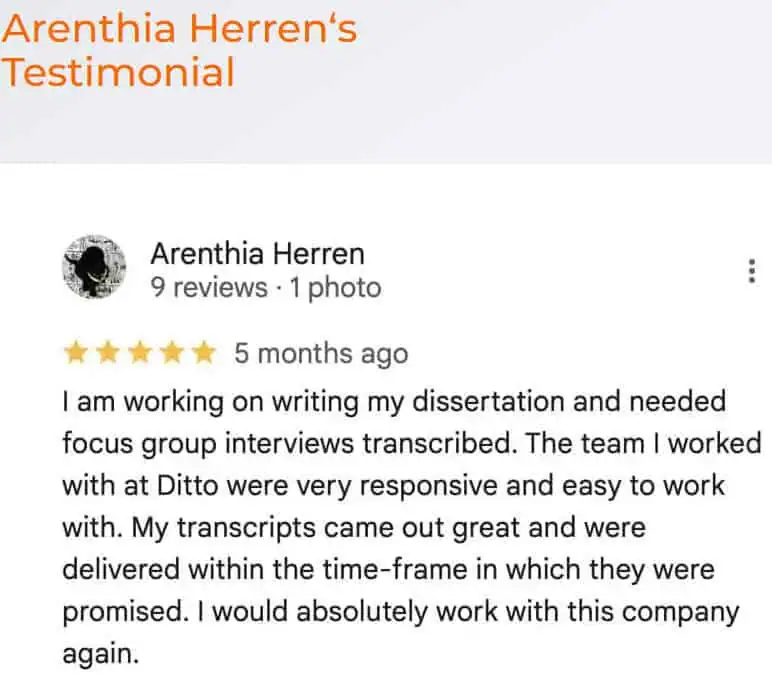
Not convinced? Here’s a client testimonial that tells you the foundations of our services.
Ditto Transcripts is a Denver, Colorado-based FINRA, HIPAA, and CJIS-compliant transcription services company that provides fast, accurate, and affordable transcripts for individuals and companies of all sizes. Call (720) 287-3710 today for a free quote.