


Having the proper paperwork when a case goes to court is critical to law enforcement. Witness statements, court transcripts—you name it, lawyers need it. However, keeping track of all these written records can be a real headache. One tiny mistake or missing piece could completely alter the outcome of the case. That’s why law enforcement and legal transcription services have become a lifesaver for legal professionals.
In this article, you’ll learn how.
- Accurate transcripts of evidence, witness statements, and court proceedings are essential in criminal cases to build strong legal strategies and ensure justice.
- Proper documentation safeguards legal evidence from misinterpretation, loss, or tampering—strengthening both prosecution and defense cases.
- Expert transcription services like Ditto Transcripts offer legally admissible, high-accuracy records that law enforcement and attorneys can rely on in any legal situation.
The Importance of Evidence in Prosecution And Criminal Defense Cases
The prosecution needs evidence to convince the judge and jury that the defendant is guilty as charged, so it needs to present rock-solid proof that leaves no room for doubt. Conversely, criminal defense attorneys can use evidence to spot errors in the prosecution’s story, muddy the waters, and even raise other possibilities for what went down.
The evidence can win or lose a case by swaying the decision-makers. Moreover, if the prosecution’s evidence is weak, their whole case could fall apart. And if the defense can’t back up its claims with hard facts, it might not stand a chance either.
That’s why courtroom transcription services play such a vital role—they ensure every word spoken during hearings, testimonies, and cross-examinations is accurately documented. These precise transcripts give both sides a dependable written record to review, reference, and use to strengthen their legal strategies.
In the end, it all boils down to which side can present the most believable evidence to tip the scales in their favor—what separates a guilty verdict from a “not guilty” one.
Types of Evidence and How They Can Build A Strong Strategy
Evidence is powerful, as it can alter a person’s life trajectory. However, understanding its importance isn’t enough. Let’s look at some common types of evidence that prosecutors or defense counsel can use to build a strategy.
| Type of Evidence | Description | Examples / Key Points | How Defense Attorneys Use It |
| Physical Evidence | Tangible items collected from the crime scene that can directly link or unlink a suspect to the offense. | DNA samples, fingerprints, weapons, ballistics, controlled substances. | Use mismatched DNA or ballistic results to raise doubts or suggest alternative scenarios. |
| Biological Evidence | Organic materials from a person or scene. | Blood, semen, hair, saliva, skin cells. | Prove the defendant wasn’t present or involved based on DNA mismatches. |
| Fingerprint Evidence | Unique ridge patterns can identify individuals. | Fingerprints at the crime scene. | Firsthand accounts from people who claim to have witnessed the crime or related events. |
| Ballistics Evidence | Firearms-related materials connecting weapons to crimes. | Guns, bullets, cartridge casings. | Dispute the match between the weapon and the crime scene evidence. |
| Documentary Evidence | Written or recorded materials that reveal important details about the case. | Emails, texts, bank statements, contracts, receipts, and medical records. | Establish alibis, show intent, or provide alternative explanations. |
| Eyewitness Testimony | Firsthand accounts from people who claim to have seen the crime or events related to it. | Witness statements, interviews, depositions. | Identify inconsistencies or biases; challenge the reliability of memory and perception. |
| Deposition Transcription Services | Verbatim written records of pre-trial witness depositions are used by both sides to prepare for court. | Accurate transcripts of interviews, cross-examinations, and sworn statements. | Ensure nothing is misinterpreted; allow attorneys to reference and analyze testimony precisely. |
| Circumstantial Evidence | Indirect evidence that implies a fact or event without direct proof. | Fingerprints, DNA traces, or other clues that suggest involvement. | Question collection methods, highlight missing pieces, or propose alternative interpretations. |
| Exculpatory Evidence | Evidence that supports the defendant’s innocence or reduces culpability. | Alibi statements, contradicting witness accounts, and DNA clearing the accused. | Use to prove innocence, create reasonable doubt, or seek case dismissal or lighter sentencing. |
Evidentiary Impact on Criminal Prosecution And Defense Cases
Since we’ve discussed the different types of evidence, understanding their potential impacts would also be best.
Establishing Reasonable Doubt
When you’re in the hot seat, accused of a crime, the idea of reasonable doubt becomes your best friend. Your lawyer’s job is to plant seeds of uncertainty in the jury’s minds about the other side’s case. They’ll spot flaws in witness stories, question if the evidence holds up, and argue that the prosecution hasn’t quite connected the dots.
The defense might float other theories or even suggest that maybe things aren’t as clear-cut as they seem. Now, if the lawyer can get the jury scratching their heads and wondering if there’s more to the story, that increases the client’s chances of winning, though it varies on the individual case.
Rebutting Prosecution Arguments
A defense lawyer’s expertise is in tearing apart the prosecution’s case, one piece at a time. They’ll leave no stone unturned, scrutinizing every witness statement, piece of evidence, and legal loophole. If something smells fishy, they’ll sniff it out and make sure the jury gets a whiff, too.
Perhaps the witness has a grudge, or another explanation points to innocence. The defense will paint a picture of doubt that could chip away at the prosecution’s case until it’s full of holes. And if the defendant’s rights were violated along the way, defense lawyers will ensure that’s front and center.
Securing Favorable Plea Deals for Defendants
In criminal justice, defense lawyers can differentiate between a criminal record and a second chance. They can use their legal acumen to deal with prosecutors, angling for a plea bargain that cuts you the best possible deal. It’s all about give and take—you agree to plead guilty, and in return, you might walk away with a lighter sentence or alternative punishments that keep you out of jail.
That’s where trial transcription services make a real difference. By providing accurate, word-for-word records of courtroom proceedings, these services help attorneys review testimony, analyze statements, and uncover details that could influence plea negotiations or future appeals. With reliable transcripts, defense lawyers can spot weaknesses in the prosecution’s arguments and use them to strengthen their bargaining position.
Your attorney will size up the prosecution’s case, factor in your history, and look for any angle to sway the tide in your favor. They’ll negotiate hard to minimize the damage of a conviction. It’s a tricky dance, yet it can be a win-win for you and the court when it works out.
Why is Effective Documentation of Evidence Crucial?
The evidence presented in the justice system can be a deciding factor in many criminal cases. Therefore, every shred of proof needs to be meticulously recorded, whether it’s fingerprints or witness statements. This documentation is the bedrock for building a strong argument, no matter if you’re a prosecutor going for a conviction or a defense lawyer fighting to clear your client’s name.
Half-baked records can make the evidence against a criminal case look flimsy. However, what if you have ridiculously accurate, word-for-word documentation? That’s where verbatim transcription services come into play. These services capture every spoken word, pause, and inflection precisely as they occur, ensuring that no critical detail is missed. This level of accuracy can fortify your position, making it far more challenging for anyone to question the validity of your evidence.
Solid evidence isn’t exclusively about strengthening your court case, though. It’s also crucial to make sure justice is served fairly and squarely. When every piece of evidence is carefully documented, it reduces the risk of tampering or loss—the integrity essential to maintaining the public’s faith in the criminal justice system.
Ways to Create a Written Record for Court Evidence
Speaking of documentation, let’s examine some ways to create written records that are admissible in courts.
Disclaimer: There are many more ways than what’s on our list; however, these are the more common ones.
| Process | Description | Purpose / Importance |
| Drafting Sworn Affidavits | Sworn affidavits are written statements made under oath by individuals (affiants) who have firsthand knowledge of the facts. Lawyers typically draft these documents to ensure clarity and legal accuracy. | Provides a formal, sworn record of testimony or observation; serves as admissible evidence in court when signed before a notary public or authorized official. |
| Compiling Expert Analysis Reports | Experts such as forensic scientists, doctors, engineers, and law enforcement specialists prepare detailed reports based on their professional analysis of evidence using scientific methods. | Offers technical insights and credible conclusions that help judges and juries understand complex issues; supports or challenges evidence presented in court often times with medical record review summaries. |
| Transcribing Crucial Recordings | Audio and video recordings—such as interviews, interrogations, and surveillance footage—are converted into precise written transcripts. Professional law enforcement transcription services, such as Ditto Transcripts, handle this task. | Ensures every spoken word and relevant sound is accurately documented for use in court; certified transcripts strengthen the admissibility and credibility of recorded evidence. |
Why Choose Ditto As Your Law Enforcement Transcription Partner?
Why you should choose Ditto Transcripts as your law enforcement transcription partner?
Our services include:

- High Accuracy: Our professional human transcription service delivers the highest possible accuracy, as close to perfection as possible.
- Flexible Turnaround Times: Depending on the project, we can provide rush and highly accurate transcripts within one or two days for those who need things done quickly.
- Stringent Security Measures: Every evidence obtained is highly safeguarded. Our CJIS compliance and robust encryption protocols will optimally protect your confidential information. We’ll answer any questions you have about our security and will be more than happy to provide proof of certification.
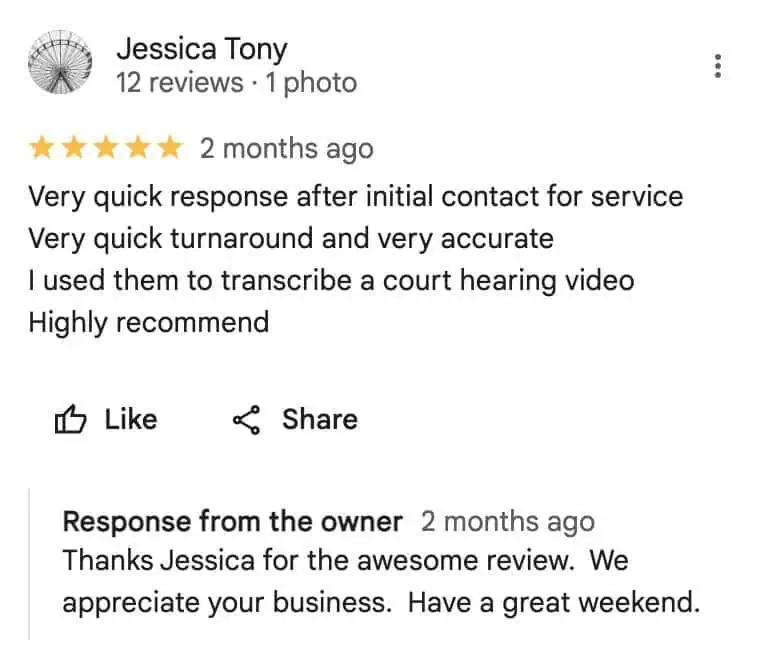
- Proven Track Record: We’ve provided high-quality transcription services to law enforcement agencies since 2010. We understand the rules of criminal procedure and the criminal justice system itself. So, rather than relying on untested providers or fancy AI tools, please put your trust in our long, proven history. Here’s a client testimonial that tells you about our services:
- Flexibility: Need timestamps or verbatim transcripts? Say the word, and we’ll get it done.
- No Long-term Contracts: Pay for what you need, when you need it, without worrying about getting tied up with long-term service commitments (though I guarantee your firm will be back for more.)
Ditto Transcripts Can Aid Prosecutors and Defense Counsel In Any Criminal Case
Ditto Transcripts has extensive knowledge of legal processes and terminology, can work within any timeline, and delivers the highest quality. Our transcription process ensures we provide 99% accuracy every time. We don’t use automated transcription, and everyone on our staff—transcribers, transcription editors, and customer service managers—is an expert in the law.
Ditto Transcripts is a Denver, Colorado-based FINRA, HIPAA, and CJIS-compliant transcription services company that provides fast, accurate, and affordable transcripts for individuals and companies of all sizes. Call (720) 287-3710 today for a free quote.