


Transcription services play a key role in converting spoken content into accurate written records. This process is used across industries that rely on documentation, compliance, accessibility, and content analysis.
Businesses, legal teams, healthcare providers, and media organizations increasingly depend on transcription services to turn audio and video into structured text that can be stored, reviewed, and shared efficiently.
In regulated environments such as legal transcription services, accuracy and confidentiality are especially critical because transcripts may become part of official case files, court records, or evidentiary documentation.
In this article, you’ll learn
- What transcription services do, and how the transcription process works
- The different types of transcription services and where they are used
- Why accuracy, confidentiality, turnaround time, and compliance matter when choosing a transcription provider
How Transcription Services Work in Practice
Most transcription services follow a structured workflow designed to ensure accuracy and consistency.
The process typically begins when a client submits an audio or video file. From there, a professional transcriptionist listens to the recording and converts spoken content into written text.
Depending on the type of transcription services requested, the output may be:
- verbatim transcription capturing every spoken word
- or a clean transcription that removes unnecessary filler while preserving meaning
Once completed, the transcript is reviewed for formatting, clarity, and accuracy before being returned to the client for use.
In industries such as court transcription services, this workflow often includes additional review steps due to the importance of precision in legal documentation.
Types of Transcription Services and Their Applications
Different transcription services are used depending on the purpose of the content being transcribed.
Verbatim transcription is commonly used in legal transcription services, law enforcement, and media recording because it captures every spoken element, including pauses, repetitions, and filler words.
Clean transcription is often preferred in business transcription, academic transcription services, and general content use where readability is more important than exact speech replication.
Other common applications include:
- interviews and focus groups
- academic research recordings
- healthcare documentation
- podcasts and media content
Across all of these, transcription services help convert unstructured audio into usable written records.
Benefits of Using Professional Transcription Services
Outsourcing transcription services provides operational and financial advantages for organizations of all sizes.
One of the most significant benefits is cost efficiency. Hiring and maintaining in-house transcription staff requires recruitment, training, equipment, and ongoing overhead costs, while outsourced transcription services eliminate many of these expenses.
Time savings are another key advantage. Professional transcription services allow teams to focus on core responsibilities rather than manually converting audio to text.
For example, legal teams using deposition transcription services can focus on case preparation instead of spending hours documenting depositions or hearings.
Other benefits include:
- improved productivity across departments
- reduced administrative workload
- scalable support for high-volume transcription needs
- consistent output quality across files
Accuracy, Quality Control, and Human Review
Accuracy is one of the most important factors when evaluating transcription services.
Even small errors in transcripts can affect meaning, particularly in legal transcription services where wording may influence case interpretation or documentation integrity.
Professional transcription services typically use multiple quality control stages, including:
- initial transcription by trained specialists
- editing for clarity and structure
- final proofreading before delivery
While automated tools can generate fast results, human review remains essential for ensuring accuracy. In benchmarking contexts, AI-assisted transcription accuracy is reported at 61.92%, which is not sufficient for professional-grade transcription services without correction and validation.
Turnaround Time and Scalability in Transcription Services
Turnaround time is a key consideration when selecting transcription services.
Most providers offer different delivery options depending on urgency and workload size. Standard turnaround may range from several days, while rush services can significantly reduce delivery time.
Professional transcription services are also designed to scale. Whether handling a single recording or hundreds of hours of audio, providers can adjust capacity without compromising consistency.
This flexibility is especially important for industries like trial transcription services, where workload can fluctuate depending on case volume.
SEO, Accessibility, and Content Value
Transcription services also provide value beyond documentation.
For digital content, transcripts improve search engine visibility by making spoken content indexable. This is particularly useful for video-based content that lacks structured metadata.
Accessibility is another important benefit. Transcription services support viewers who are deaf or hard of hearing by providing readable versions of spoken content. They also make information easier to search and reference without replaying audio.
Security, Confidentiality, and Compliance in Transcription Services
Security is a core requirement for modern transcription services, especially in regulated industries.
Sensitive recordings may include legal discussions, medical information, or confidential business communications. As a result, transcription services must implement strong safeguards such as:
- encrypted file transfer
- restricted access systems
- confidentiality protocols
- compliance with frameworks like HIPAA or CJIS
These protections are particularly important in government transcription services, where improper handling of data can create significant risk.
Why Clients Choose Ditto for Transcription Services
High-quality transcription services are defined by more than speed. They require accuracy, confidentiality, and consistent handling of complex audio across different industries.
At Ditto Transcripts, we support legal teams, courts, researchers, healthcare providers, academic institutions, and businesses that rely on transcription services for reliable documentation.
Clients choose Ditto because we offer:
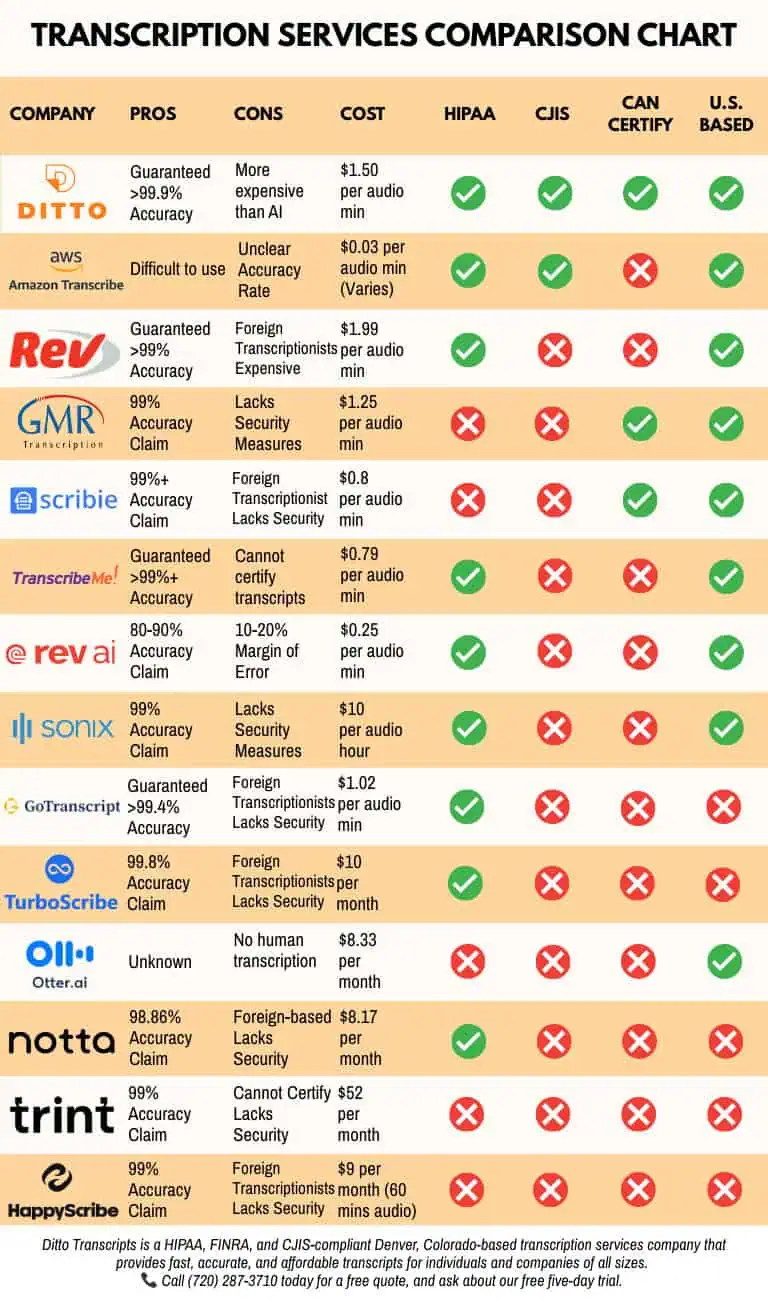
- Human transcriptionists: Every file is processed by trained professionals who understand context, terminology, and speaker intent across use cases for different transcription services.
- Legal transcription services specialization: Depositions, hearings, and court recordings are handled with strict attention to verbatim accuracy and structured formatting requirements.
- Secure transcription workflows: Files are processed through controlled systems that protect confidentiality throughout transcription.
- Compliance-ready handling: Support for HIPAA, CJIS, and other regulated requirements depending on client needs.
- Flexible turnaround options: Delivery timelines are adapted based on urgency and volume.
- Transparent legal transcription prices: Pricing is based on recording length, complexity, and turnaround requirements, helping organizations manage transcription services costs predictably.
- No long-term contracts: Clients can scale transcription services usage based on workload without restrictive commitments.
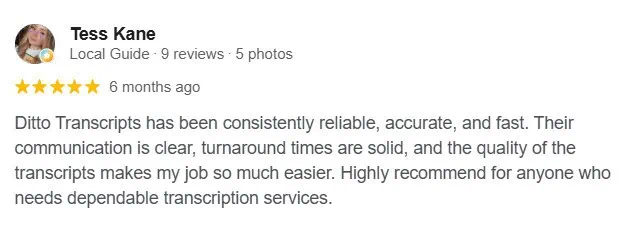
Before choosing a provider, it can also help to review Ditto Transcripts testimonials to see how clients describe their experience with the company’s accuracy, security, service quality, and overall reliability. Here’s one:
Final Considerations on Transcription Services
Selecting transcription services requires balancing accuracy, security, turnaround time, and cost transparency.
The strongest providers are those that maintain consistency across industries while adapting to different audio conditions and workflow demands.
Whether used for legal documentation, academic research, or business communication, transcription services remain essential for turning spoken content into accurate, usable written records that support decision-making and compliance.
Ditto Transcripts is a Denver, Colorado-based transcription services company that provides fast, accurate, and affordable transcripts for individuals and companies of all sizes and is FINRA-, HIPAA-, and CJIS-compliant. Call (720) 287-3710 today for a free quote.